Our Top Picks
🛒 Best Price Today on Amazon
Check today’s deals on the products above before you buy. Prices change often, so compare the live price on Amazon.
Best Deck and Step Lights
The best deck and step lights for most homes are low-voltage LED fixtures: they offer more dependable brightness and weather resistance than solar lights without the electrical complexity and running cost of full-voltage wired lighting. Solar is the easiest choice for small, sunny installations, while wired lighting makes sense when you need consistent illumination through winter, shade, or long nights.
Solar vs. Wired vs. Low-Voltage: The Quick Verdict
| Light type | Typical brightness | Weather resistance | Installation difficulty | Beam spread | Typical running cost | Best for |
|---|---|---|---|---|---|---|
| Solar LED | 10–80 lumens per fixture | IP44–IP65 | Easy; mounting only | 30–120 degrees | Usually under $2 per year per light | Small steps, sunny decks, decorative accents |
| Low-voltage LED | 40–300 lumens per fixture | IP65–IP67 | Moderate; transformer and cable required | 30–120 degrees | About $2–$8 per year per light | Most decks, stairs, paths, and railings |
| Line-voltage wired LED | 150–800+ lumens per fixture | IP65–IP67 | Advanced; often requires an electrician | 15–120 degrees | About $4–$15 per year per light | Large areas and permanent high-output lighting |
These are useful planning ranges rather than guarantees. Actual output depends on lens design, mounting height, battery capacity, transformer efficiency, and whether the manufacturer reports raw LED output or useful light leaving the fixture.
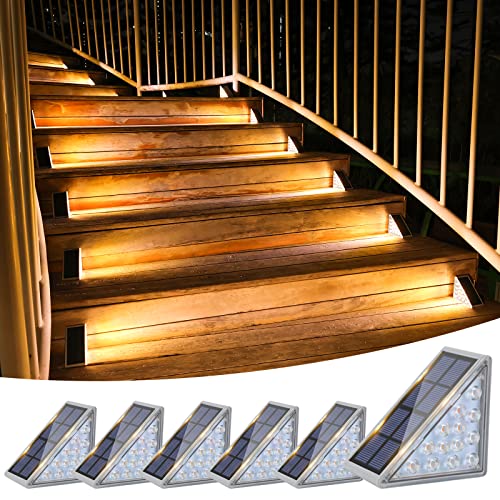
VOLISUN Solar Stair Lights 6 Pack, Solar Step Lights Outdoor Waterproof | IP67, LED Outdoor Step Light,Outdoor Light Decor for Garden Stair, Deck, Front Step, Front Porch, and Patio(3000K)
Chosen because it specifies Solar Step Lights Outdoor Waterproof.
View on Amazon
Warm White Solar Lights for Deck Step Fence, Black SST Housing, 6 Pack | Soft warm non-glare LED, sturdy stainless steel casing , outdoor use, Rainproof, Automatic ON/OFF, not excessively bright
Chosen because it specifies Black SST Housing and 6 Pack.
View on Amazon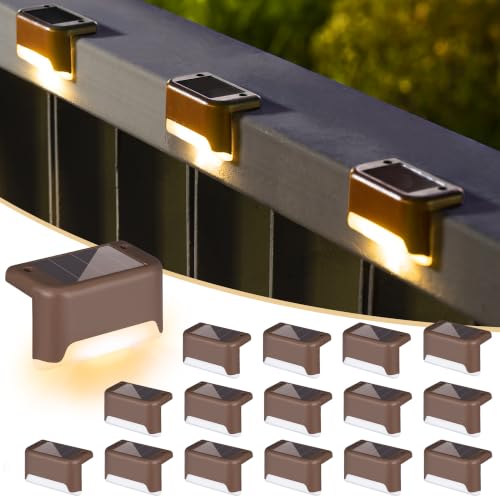
SOLPEX Solar Deck Lights Outdoor 16 Pack,Step Light Waterproof,Warm White | Led Solar lights for Outdoor Stairs,Step,Fence,Yard,Garden,Patio and Pathway
Chosen because it specifies Step Light Waterproof and Warm White.
View on Amazon
GIGALUMI Led Solar Deck Lights, 16 Pack,Waterproof, Warm White | LED Solar Deck Lights for Outdoor Stairs, Step, Fence, Railing, Yard and Patio
Chosen because it specifies 16 Pack,Waterproof and Warm White.
View on AmazonHead-to-Head Comparison
Solar lights: simplest installation, least predictable output
Solar lights contain a photovoltaic panel, rechargeable battery, and LED, so installation normally means attaching the fixture or pushing a stake into place. They are a good fit when running cable would be difficult, when you only need gentle marker lighting, or when the deck receives several hours of direct sunlight.
The main limitation is energy storage. A small solar light may produce 20 lumens for eight hours after a bright summer day, but considerably less after cloudy weather, snow, or winter shade. Avoid relying on solar units as the only safety lighting on heavily used stairs unless they have a large panel, a replaceable rechargeable battery, and a brightness rating suitable for the area.
Look for an IP65 rating or higher if the fixture will be exposed to wind-driven rain. IP44 can be adequate under a covered roof, but it offers less protection from water. Solar panels also need occasional cleaning because dust, pollen, and bird residue reduce charging performance.
Low-voltage lights: the best balance for most decks
Low-voltage systems normally use a plug-in transformer that converts household power to 12 or 15 volts. A weather-rated cable runs from the transformer to each fixture. This arrangement provides substantially more consistent output than solar lighting and is safer to work with than line-voltage wiring, although outdoor electrical rules still matter.
Low-voltage LED fixtures are available as recessed step lights, surface-mounted deck lights, post-cap lights, and directional spotlights. Choose a transformer with capacity above the calculated load rather than matching the rating exactly.
For example, suppose you install eight 3-watt step lights and four 2-watt post lights:
- Step lights: 8 × 3 watts = 24 watts
- Post lights: 4 × 2 watts = 8 watts
- Total fixture load: 32 watts
- Recommended transformer size with 25 percent spare capacity: 32 × 1.25 = 40 watts
A 60-watt transformer would provide comfortable headroom for cable losses or a later fixture addition. This matters because an undersized transformer can cause dim lights, unreliable timers, and premature failure.
Line-voltage wired lights: maximum output and permanence
Line-voltage lighting connects directly to the building’s electrical system and can power brighter fixtures over longer cable runs. It is appropriate for a broad deck, entertaining area, or stairs that need strong illumination throughout the night. The trade-off is installation complexity: outdoor circuits require suitable junction boxes, cable protection, grounding, and weatherproof connections.
Unless you already have the required electrical experience and your local rules permit the work, use a qualified electrician. A line-voltage system may cost more to install, but it can support high-output lights, smart controls, and long-term expansion without the voltage-drop concerns found in some low-voltage layouts.
How Bright Should Deck and Step Lights Be?
Brightness should match the task, not simply be as high as possible. Excessive brightness creates glare, makes nearby areas appear darker, and can shine into windows or neighboring properties.
| Application | Suggested output per fixture | Recommended beam | Placement guidance |
|---|---|---|---|
| Step tread marker | 10–40 lumens | Wide, 90–120 degrees | Hide below the tread edge or on the riser |
| Stair landing | 40–100 lumens | Wide or diffuse | Light the landing from two directions where possible |
| Deck perimeter | 30–100 lumens | Wide wash | Space fixtures evenly instead of concentrating them at corners |
| Post or feature light | 50–150 lumens | 30–60 degrees | Use as an accent or orientation point |
| Nearby path or dark approach | 100–300 lumens | 30–90 degrees | Aim downward to avoid glare |
For stairs, even spacing and shadow control are usually more important than maximum lumens. A 25-lumen fixture on every riser can be safer and more comfortable than two 150-lumen spotlights that leave the middle steps dark.
Beam Spread and Light Placement
A narrow 15–30-degree beam reaches farther but produces bright spots and sharp shadows. It works well for highlighting a post, tree, or architectural feature. A 60–120-degree beam spreads light across treads and deck surfaces, making it better for movement and general visibility.
Do not point fixtures directly toward the top of the stairs or toward eye level. Mount step lights slightly above the tread, aim them down, and use a shielded or frosted lens where possible. On a deck, place lights under railings or beneath seating-height edges to illuminate the floor without exposing the LED directly to people’s eyes.
Weather Resistance: What the IP Rating Means
The first IP digit describes protection from solid objects and dust; the second describes water resistance. For outdoor deck lighting, the second digit is especially important:
- IP44: protected from splashing water; best for covered locations.
- IP54: limited dust protection and resistance to water spray.
- IP65: dust-tight and protected against water jets; a strong general-purpose target.
- IP67: dust-tight and capable of temporary immersion; useful for exposed or low-mounted fixtures.
An IP rating applies to the fixture under specified test conditions, not automatically to every cable joint, connector, or transformer. Place connections above standing water, use outdoor-rated connectors, and provide a drip loop so rain does not run along a cable into the connection.
Decision Matrix: Which System Fits Your Deck?
| Your situation | Best choice | Why |
|---|---|---|
| Four to six steps with full afternoon sun | Solar, 20–50 lumens per step | Simple installation and modest light demand |
| Shaded deck or northern exposure | Low-voltage LED | Consistent output without depending on daily charging |
| Long stairs used every night | Low-voltage or line-voltage LED | Better reliability and controllable brightness |
| Large deck with existing outdoor circuit | Line-voltage or professionally installed low-voltage | Supports longer runs and more powerful fixtures |
| Rental property or temporary project | Solar surface-mounted lights | Minimal wiring and easier removal |
| Frequent winter cloud, snow, or short daylight | Wired LED | Output does not depend on battery recovery |
Running Cost Calculation
LED lighting is inexpensive to operate, but the difference between systems becomes clearer when you calculate it. Ten 3-watt low-voltage lights running for five hours each night use:
10 × 3 watts × 5 hours × 365 days ÷ 1,000 = 54.75 kilowatt-hours per year.
At an electricity rate of $0.18 per kilowatt-hour, the fixture energy costs about $9.86 per year, before transformer losses. Allowing roughly 15 percent for transformer and control consumption brings the total to approximately $11.30 annually. Solar has almost no electricity cost, but its batteries commonly need replacement every one to three years, depending on quality, temperature, and charging conditions.
Buying Checklist
- Choose the required brightness by application rather than selecting the highest lumen number.
- Prefer IP65 for exposed fixtures and IP67 for locations near puddles, soil, or snow accumulation.
- Check color temperature: 2700–3000K gives a warm, comfortable appearance; 4000K looks crisper but can feel harsh on a residential deck.
- For solar lights, verify battery capacity and replaceability, not just the claimed runtime.
- For low-voltage systems, calculate total wattage and leave at least 25 percent transformer headroom.
- Use shielded lenses and downward aiming to reduce glare.
- Confirm that cable connectors, timers, photocells, and transformers are rated for outdoor use.
Bottom Line
Choose solar lights when convenience and low installation effort matter most and the area receives reliable sun. Choose low-voltage LED lights for the best overall combination of brightness, beam control, weather resistance, and manageable running cost. Choose line-voltage wired lighting when you need the highest output, long cable runs, or a permanent professionally installed system. For most residential stairs, several evenly spaced 20–60-lumen low-voltage fixtures with a wide downward beam will provide safer, more useful illumination than a few overly bright spotlights.
FAQ
How Bright Should Deck and Step Lights Be?
More from Amazon
Programs that pair well with the guide above. Offers and eligibility are set by Amazon and may change.
A free business account with business pricing and bulk-buying tools for work, shop or home office.
Create a business accountFree shipping on eligible items, Prime Video and more. Eligible new members can start with a free trial.
Start a Prime free trialAudiobooks and podcasts to listen to on the go. Eligible new members can start with a free trial.
Try Audible freeAd-free music streaming. Eligible new subscribers can start with a free trial.
Try Music Unlimited freeAs an Amazon Associate we earn from qualifying purchases.