Our Top Picks
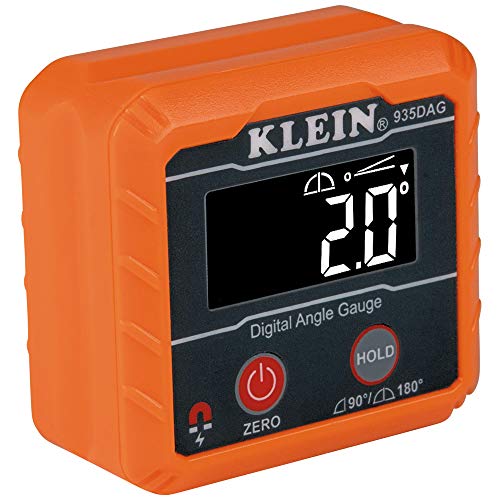 Klein Tools 935DAG Digital Electronic Level and AngleLevel2.36 x 2.2 x 1.2 inches0.2 poundsCheck on Amazon
The best digital angle finders for miter saw setup deliver ±0.05° to ±0.1° accuracy, strong magnetic bases, and a readable display — and for most woodworkers in 2026, the sweet spot sits between $30 and $80, led by proven options like the Klein Tools 935DAG, Wixey WR300, and GemRed digital angle finder.
🛒 Best Price Today on Amazon
Check today’s deals on the products above before you buy. Prices change often, so compare the live price on Amazon.
Why a Digital Angle Finder Beats the Saw’s Built-In Scale
Factory miter saw detents and engraved scales are typically accurate to about ±0.5° on a good day — fine for framing, unacceptable for finish carpentry. A 0.5° error on a 45° miter across an 8-inch wide trim board leaves a visible gap of roughly 1/16 inch at the joint face. Digital angle finders resolve to 0.05° or better, which is why cabinet-grade miter work demands one.
Klein Tools 935DAG Digital Electronic Level and Angle Gauge | Measures 0 - 90 and 0 - 180 Degree Ranges, Measures and Sets Angles
Picked as a relevant option in this category.
View on Amazon
Klein Tools 935DAF Digital Angle Finder, Precision Measurements | Miter Saw Protractor Angle Calculation and Portable Design
Chosen because it specifies Precision Measurements.
View on Amazon
Wixey Digital Angle Gauge for Table Saw & Miter Saw, Magnetic | Digital Angle Gauge – Precision Angle Setup – Angle Finder – Magnetic Base – Easy-Read Display
Chosen because it specifies Magnetic.
View on Amazon
S&F STEAD & FAST Digital Angle Finder Tool, IP54, 7 Inch / 200 mm | Miter Button, ±0.2 Accuracy, Stainless Steel Arms, Locking Knob, Digital Protractor for Woodworking, Trim & Crown Molding
Chosen because it specifies 7 Inch / 200 mm.
View on AmazonThe tool serves two jobs: verifying that your blade is actually at the angle the scale claims, and setting repeatable angles for repeated cuts (returning to the same bevel for an entire crown molding run, for example).
What Separates a Good Angle Finder From a Bad One
- Accuracy and resolution: Look for ±0.1° accuracy minimum, ideally ±0.05°. Resolution of 0.05° means the display shows increments useful for trim work; 0.1° resolution is acceptable but coarser.
- Magnetic base strength: The tool spends most of its life stuck to your blade or table. Weak magnets mean the finder shifts mid-reading, producing phantom errors. Rare-earth magnets are standard on quality units.
- Display readability: Backlit LCD with auto-rotate matters more than it sounds — you’ll often read the display upside down or in a dim shop corner. The Klein 935DAG and Wixey WR300 both auto-invert.
- Calibration and zeroing: A relative-zero function lets you set any reference surface as 0°, which is how you measure the difference between blade and fence rather than absolute angles. One-button zeroing is essential; multi-step calibration routines get skipped in practice.
- Battery life: Most units run 200–500+ hours on AAA or coin cells. Auto-shutoff after 5–10 minutes is standard — check that it retains its zero through power-off, or you’ll re-calibrate constantly.
- Range: Single-axis units measure 4×90° (fine for miter saws). Dual-axis units add cost without benefit for this specific job.
Comparison: Recommended Models in 2026
| Model | Accuracy | Resolution | Magnetic Base | Battery | Typical Price Range |
|---|---|---|---|---|---|
| Wixey WR300 Type 2 | ±0.1° | 0.05° | Yes, bottom face | AAA, ~250 hrs | $30–$40 |
| Klein Tools 935DAG | ±0.1° | 0.05° | Yes, strong rare-earth | AAA, ~300 hrs | $35–$50 |
| GemRed Digital Angle Finder | ±0.2° | 0.1° | Yes | CR2032 | $20–$30 |
| iGaging AngleCube | ±0.2° | 0.05° | Yes, three faces | AAA | $30–$45 |
| Bosch GAM 220 MF | ±0.1° | 0.05° | Yes, multiple faces | AA, extended runtime | $100–$140 |
Best Overall: Wixey WR300
The WR300 remains the workshop standard because it nails the fundamentals: 0.05° resolution, a zero function that survives power-off, and magnets strong enough to hold on a vertical blade. It’s the default recommendation for miter saw calibration.
Best for Jobsite Durability: Klein 935DAG
IP42 dust/water resistance, a rubber overmold, and a noticeably stronger magnetic grip make this the pick if the tool lives in a tool bag rather than a shop drawer. Accuracy matches the Wixey.
Best Premium Option: Bosch GAM 220 MF
Four measurement modes, leg-extension measurement for longer references, and ±0.1° accuracy. Worth it for trim carpenters who also verify table saw bevels and jointer fences — overkill for occasional miter checks.
How to Calibrate Your Miter Saw With One (Step by Step)
- Step 1 — Zero on the table: Place the finder flat on the miter saw table and press the zero button. This makes the table your reference plane, canceling out whether the saw sits perfectly level on your bench. This is the step people skip — absolute level doesn’t matter, only the blade-to-table relationship does.
- Step 2 — Check the 90° stop: Stick the finder magnetically to the blade plate (avoid carbide teeth — use the flat body of the blade). It should read 0.0°±0.1°. If it reads 0.4°, adjust the saw’s 90° stop screw until it reads true.
- Step 3 — Verify detents: Repeat at 45° and 22.5°. Most saws are off by 0.2–0.5° at detents even when 90° is dead-on.
- Step 4 — Test cut and iterate: Make a scrap cut, measure the offcut with the finder laid across the cut face, and fine-tune. Two iterations usually converges to under 0.1° error.
A Worked Example: Why 0.1° Matters for Crown Molding
Take a 52°/38° crown molding installed in a 10-foot-long room. An angular error of θ on a mitered corner creates a gap g ≈ width × tan(θ). For a 4.5-inch-wide crown:
- 0.5° error: 4.5 × tan(0.5°) ≈ 0.039 in gap — a clearly visible sliver that caulk won’t hide cleanly on stained trim.
- 0.1° error: 4.5 × tan(0.1°) ≈ 0.008 in — invisible under paint, marginal under stain.
This is the concrete payoff: ±0.1° accuracy is the threshold where miter gaps stop being visible. A ±0.3° “budget” gauge saves $15 and costs you every corner.
Decision Matrix: Which One for Your Situation
| Your situation | Recommendation | Why |
|---|---|---|
| Weekend DIY, occasional trim work | GemRed or similar $20–30 class | ±0.2° is adequate for painted trim and picture frames |
| Serious hobbyist / furniture maker | Wixey WR300 | Best accuracy-per-dollar; retains zero across power cycles |
| Jobsite finish carpenter | Klein 935DAG | Survives drops and dust; strongest magnet |
| Multi-tool shop calibration | Bosch GAM 220 MF | Leg extension reaches across wide table saw surfaces |
| Crown molding specialist | Any ±0.05–0.1° unit + protractor head | Add an 18-inch digital protractor for reading wall angles |
Common Mistakes That Produce False Readings
- Sticking the finder to blade teeth: Carbide teeth vary in height by several thousandths; always use the flat plate between teeth.
- Sawdust on the magnet: A single chip under the base tilts the unit and adds 0.1–0.3° of phantom error. Wipe the magnet before every reading.
- Measuring with the blade guard interfering: Pull the guard fully back or remove the finder after lowering the blade, not during.
- Ignoring battery sag: Low batteries cause drift on cheaper units. If readings wander by more than the spec tolerance with a fresh zero, swap the cell before blaming the saw.
FAQ
Do I need ±0.05° or is ±0.1° enough?
±0.1° is enough for any trim work — it’s below the visible-gap threshold for boards up to about 6 inches wide. ±0.05° adds headroom for wide glue-ups but doesn’t change real-world results for most users.
Will the magnet damage my blade or pull filings into the mechanism?
No — the magnets hold to the blade face, not the motor. Brush the tool clean after use and it won’t carry filings anywhere.
Can I use one angle finder for miter, bevel, and table saw checks?
Yes. Zero on each tool’s table, then read the blade. The same workflow covers miter saws, table saw bevel angles, bandsaw tables, and drill press tables.
How often should I re-zero?
Re-zero every time you move to a new reference surface, and any time readings look inconsistent. It takes three seconds — there’s no reason not to.
FAQ
Do I need ±0.05° or is ±0.1° enough?
Will the magnet damage my blade or pull filings into the mechanism?
Can I use one angle finder for miter, bevel, and table saw checks?
How often should I re-zero?
More from Amazon
Programs that pair well with the guide above. Offers and eligibility are set by Amazon and may change.
A free business account with business pricing and bulk-buying tools for work, shop or home office.
Create a business accountFree shipping on eligible items, Prime Video and more. Eligible new members can start with a free trial.
Start a Prime free trialAudiobooks and podcasts to listen to on the go. Eligible new members can start with a free trial.
Try Audible freeAd-free music streaming. Eligible new subscribers can start with a free trial.
Try Music Unlimited freeAs an Amazon Associate we earn from qualifying purchases.