Key takeaways
- Light-duty sheet steel: suitable for cleaning supplies, empty boxes, and lightweight plastic bins.
- Medium-duty steel: a good target for tools, computer components, cables, and small appliances.
- Heavy-duty welded steel: preferable for compressors, dense hardware, vehicle parts, and frequent daily use.
The best garage storage cabinets for small spaces are usually 30–36 inches wide, 18–24 inches deep, lockable, and rated for at least 600 pounds overall; choose a welded steel cabinet for maximum durability or a modular cabinet system when you need to fit around doors, vehicles, and gaming equipment.
Best garage storage cabinets at a glance
| Cabinet type | Typical dimensions | Typical capacity | Best for | Main compromise |
|---|---|---|---|---|
| Narrow freestanding steel cabinet | 30–32 W × 18–20 D × 60–72 H in. | 400–800 lb total | Tight garages and tool storage | Less shelf depth for large cases |
| Standard double-door cabinet | 36–48 W × 18–24 D × 60–72 H in. | 600–1,200 lb total | General-purpose storage | Needs more door and walking clearance |
| Modular garage cabinet system | 24–36 W per module × 20–24 D | 500–1,000 lb per cabinet | Building storage around a workstation | Usually costs more per cubic foot |
| Tall locker cabinet | 18–24 W × 18–24 D × 72–84 H in. | 300–700 lb total | Vertical storage for long or bulky items | Narrow shelves can be awkward to organize |
Which cabinet fits your garage?
| Your situation | Recommended choice | Specifications to prioritize |
|---|---|---|
| You park a car beside the cabinet | 30–32-inch-wide narrow cabinet | 18–20-inch depth, flush handles, wall anchoring |
| You store power tools, batteries, and hand tools | Lockable steel cabinet with adjustable shelves | 600-pound-plus rating, 20–24-inch shelf depth, ventilated battery area |
| You need a cabinet beside a gaming desk | Low modular cabinet or narrow tall cabinet | Quiet doors, cable clearance, smooth finish, anti-tip hardware |
| Your garage is damp or unheated | Powder-coated steel cabinet with raised base | Sealed edges, corrosion-resistant coating, rubber feet, moisture control |
| You may move or redesign the garage later | Knock-down modular cabinet | Manageable package weight, replaceable shelves, clear assembly instructions |
Dimensions matter more than advertised capacity
Measure the usable space rather than the wall. Leave at least 3 inches from a side wall if the cabinet has doors that swing outward, and allow roughly 30–36 inches of clear walking space in front. If a vehicle shares the bay, open its doors and trunk before choosing a cabinet depth.
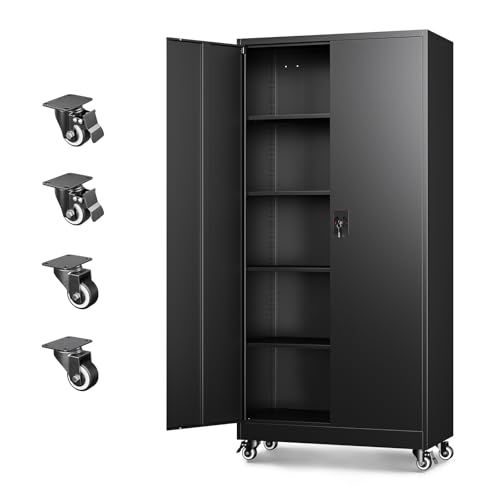
Letaya Metal Garage Storage Cabinets with Wheels,Steel Tool Cabinets Lock Door and Adjustable Shelves for Home,Office,Warehouse Organisieren (Black, 74.41" H)
Included for 'Best Garage Storage Cabinets for Small Spaces' because the listing specifies Office and Warehouse Organisieren (Black, details this guide uses to compare options.
View on Amazon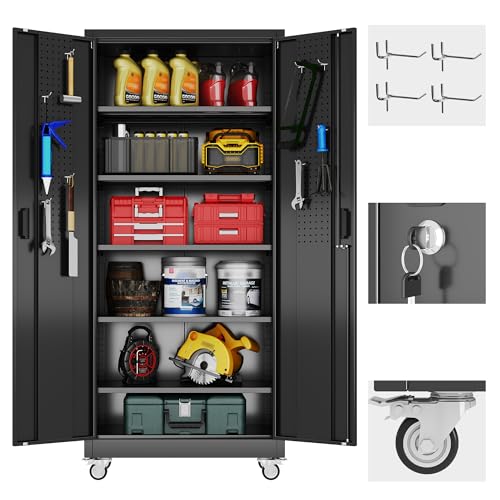
Reemoon 5 Adjustable 170 lb Shelves, Lockable Doors, Door pegboard and 4 Removable casters for Garage, Utility Storage.
Included for 'Best Garage Storage Cabinets for Small Spaces' because the listing specifies Lockable Doors and Door pegboard and 4 Removable casters for Garage, details this guide uses to compare options.
View on Amazon
Sterilite 4 Shelf Cabinet, Lockable Utility Storage, Gray
Included for 'Best Garage Storage Cabinets for Small Spaces' because the listing specifies Lockable Utility Storage and Gray, details this guide uses to compare options.
View on Amazon
Aobabo 71" Metal Storage Cabinet with Wheels, 5 Shelves & Pegboards, Black
Included for 'Best Garage Storage Cabinets for Small Spaces' because the listing specifies 5 Shelves & Pegboards and Black, details this guide uses to compare options.
View on AmazonA cabinet listed as 24 inches deep may be 24 inches deep at the body but 26–28 inches deep with handles, hinges, or a rear anti-tip bracket. For a small garage, a 20-inch-deep cabinet often offers a better balance than a nominally larger 24-inch model.
Use this simple capacity calculation before buying: multiply the usable shelf width by shelf depth and by the number of shelves. For example, four shelves measuring 28 by 18 inches provide 2,016 square inches of shelf area. That is enough for several tool cases and storage bins, but not enough to place two rows of deep bins without losing visibility. One-row storage is usually more usable than a cabinet packed to its back wall.
Steel thickness and construction
Steel thickness is commonly described by gauge, and a lower gauge number means thicker steel. A cabinet made from approximately 18–20 gauge steel is generally more resistant to dents and twisting than a lightweight 22–24 gauge cabinet. The exact gauge is less important than the combination of steel thickness, folded edges, shelf supports, door reinforcement, and weld quality.
- Light-duty sheet steel: suitable for cleaning supplies, empty boxes, and lightweight plastic bins.
- Medium-duty steel: a good target for tools, computer components, cables, and small appliances.
- Heavy-duty welded steel: preferable for compressors, dense hardware, vehicle parts, and frequent daily use.
Look underneath the cabinet and inside the doors. A reinforced door with a full-height stiffener resists sagging better than a flat sheet-metal door. Shelves should sit on multiple steel clips or rails rather than four small tabs. Welded cabinets are usually stronger and more rigid, while knock-down cabinets are easier to transport through a narrow doorway.
Weight capacity: plan for concentrated loads
The published total capacity may assume evenly distributed weight. A toolbox creates a concentrated load, so do not place the heaviest item in the center of a wide shelf unless the shelf has a center support or a high-capacity rating.
For example, suppose a cabinet is rated for 800 pounds across four shelves and the cabinet body itself supports 100 pounds. That leaves about 175 pounds per shelf under an even-load assumption. If one 120-pound toolbox occupies half of the top shelf, it may be within the total rating but still stress the shelf panel or clips. Put dense items on the lowest shelf and use a cabinet with a stated shelf rating of at least 150–200 pounds when storing power tools or automotive parts.
Locking systems and everyday access
A lock is useful for keeping children away from chemicals, protecting expensive tools, and preventing casual access to spare electronics. It is not a substitute for anchoring: a lightweight cabinet can still tip or be moved.
- Cam lock: compact and common; adequate for general household security.
- Three-point locking system: engages the top, middle, and bottom of the door; better for tall cabinets and doors that tend to flex.
- Padlock-ready hasp: convenient if several family members need access, but the exposed lock can interfere with narrow walkways.
- Electronic lock: convenient but adds batteries and another component that can fail in cold or damp conditions.
For most garages, a keyed cam lock or three-point lock is the sensible choice. Keep a spare key outside the cabinet but inside the home, and check whether the lock secures both doors or only the primary door.
Adjustable shelving for gaming and tool gear
Fixed shelves can be strong, but adjustable shelves are more valuable in a small space because storage needs change. Look for shelf spacing in the region of 1–2 inches, allowing you to create a tall compartment for a PC case, a medium compartment for consoles, and shallow sections for controllers, cables, and small bins.
For a gaming setup, reserve at least 8–12 inches of vertical clearance for accessories and 18–24 inches for larger desktop towers, depending on the case. Do not operate a PC inside a closed cabinet unless the cabinet is specifically ventilated and the equipment has adequate airflow. A closed steel enclosure can trap heat and increase dust accumulation around intake vents.
Assembly requirements and installation
Check the package weight before ordering. A tall welded cabinet may arrive assembled but be difficult to carry through a house or around a parked vehicle. Knock-down cabinets reduce shipping size but require careful squaring during assembly; a cabinet that is slightly out of square may have doors that rub or fail to latch.
- Assemble the cabinet on a flat surface and leave all fasteners slightly loose.
- Square the frame by measuring both diagonals and tightening only when they match closely.
- Install shelves after the body is stable, placing the strongest shelf supports on the lower levels.
- Attach the anti-tip bracket to a wall stud or suitable masonry anchor.
- Load heavy items low, then test the doors and lock before final organization.
For a concrete garage wall, use anchors rated for the wall material rather than relying on drywall hardware. If the cabinet has adjustable leveling feet, use them before anchoring so the frame is not forced into alignment by the wall bracket.
Moisture resistance and corrosion prevention
Powder coating protects the visible steel surface, but water can still enter through unsealed seams, screw holes, and the cabinet base. In a humid garage, choose a raised or legged cabinet instead of one sitting directly on the slab. Keep the lowest shelf several inches above the floor when possible.
Do not store damp gardening tools, wet sports equipment, or opened chemicals against bare steel. Use plastic bins with lids, leave a small air gap behind containers, and place a rechargeable desiccant unit inside the cabinet. A hygrometer is useful: sustained humidity above about 60% increases the risk of surface corrosion, especially around scratched edges.
Inspect the bottom corners twice a year. Wipe condensation, touch up scratches with a compatible enamel, and avoid placing cardboard directly on the floor. If the garage floods or regularly develops standing water, no ordinary steel cabinet is waterproof; raise the cabinet and store sensitive electronics in sealed containers.
What to expect to pay
Basic narrow steel cabinets generally fall around $150–$300. Better-built lockable cabinets with thicker panels and stronger shelves are commonly $300–$700, while modular systems and heavy-duty welded cabinets can reach $700–$1,500 or more depending on size and accessories. Compare the cost of shelves, leveling feet, locks, and shipping, since a low headline price may exclude useful hardware.
Final buying checklist
- Measure body depth, handle depth, door swing, and front clearance.
- Choose at least 600 pounds of total capacity for mixed tool and equipment storage.
- Prefer medium- or heavy-duty steel when storing dense items.
- Confirm the individual shelf rating, not just the cabinet’s total rating.
- Choose adjustable shelves with multiple height positions.
- Use a three-point lock for tall cabinets or a cam lock for ordinary storage.
- Require anti-tip hardware and anchor the cabinet after leveling.
- For damp garages, prioritize a raised base, powder coating, and sealed storage bins.
For most small garages, the strongest all-round choice is a 30–36-inch-wide, 18–24-inch-deep steel cabinet with adjustable shelves, a lock, at least 600 pounds of capacity, and a raised or anchorable base. That combination preserves floor space without forcing you to sacrifice security, organization, or long-term durability.