Key takeaways
- Multi-floor maps: Important for homes with stairs. The robot cannot climb stairs, but it can often save maps for different levels.
- Room-specific cleaning: Lets you vacuum the kitchen after dinner without running the whole house.
- No-go zones: Use them around charging cables, delicate rugs, pet feeding areas, and floor vents.
- Carpet recognition: A robot should be able to increase vacuuming on carpet and avoid wetting it.
- Obstacle recognition: Cameras and structured sensors reduce encounters with toys and cables, but they do not replace floor preparation.
- Map editing: Look for room splitting, merging, virtual walls, and adjustable cleaning direction.
The best self emptying robot vacuums for most homes are the Roborock Saros 10R, Dreame X50 Ultra, Narwal Freo Z Ultra, eufy S1 Pro, and Shark PowerDetect NeverTouch Pro, but the right choice depends more on floor type, pet hair, dock space, and maintenance tolerance than on suction claims alone.
Quick comparison: which robot vacuum fits your home?
| Model | Best suited to | Docked dust capacity | Approx. dock footprint | Notable strengths | Main compromise |
|---|---|---|---|---|---|
| Roborock Saros 10R | Mixed floors, low furniture, obstacle-heavy homes | About 2.5 L dust bag | About 30 × 42 cm | Low-profile robot, strong mapping, edge and obstacle handling | Premium price; mop-washing system needs regular cleaning |
| Dreame X50 Ultra | Homes with thresholds, carpets, and extensive automation needs | About 3.2 L dust bag | About 34 × 46 cm | Threshold-climbing design, powerful cleaning system, hot-water mop care | Large dock and higher ongoing consumable cost |
| Narwal Freo Z Ultra | Hard floors, mopping, and homes needing detailed obstacle recognition | About 2.5–2.8 L dust bag | About 34 × 46 cm | Excellent mop automation and dual-camera obstacle detection | Less compelling if carpet and deep pet-hair pickup are priorities |
| eufy S1 Pro | Mostly hard floors and frequent wet cleaning | About 2.5 L dust bag | About 38 × 47 cm | Roller-mop design continuously washes the cleaning roller | Less versatile on thick carpet; unusually deep dock |
| Shark PowerDetect NeverTouch Pro | Pet owners wanting a simpler, often lower-cost option | Up to about 60 days of debris storage, depending on use | Roughly 38 × 45 cm | Self-emptying, carpet detection, pet-hair-focused brush design | Mapping and mopping automation are less comprehensive than premium rivals |
Dimensions and capacities can vary by regional version and dock configuration. Treat the figures as planning values, and check the exact model listed in your country before measuring a cabinet or ordering replacement bags.

Shark AV2501S AI Ultra Robot Vacuum, with Matrix Clean, Home Mapping, 30-Day Capacity HEPA Bagless Self Empty Base, Perfect for Pet Hair, Wifi, Dark Grey
Included for 'Best Self-Emptying Robot Vacuums for Every Home' because the listing specifies with Matrix Clean and Home Mapping, details this guide uses to compare options.
View on Amazon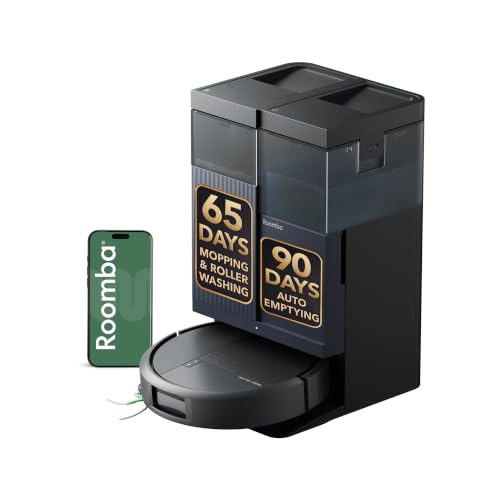
iRobot Roomba 415X Robot Vacuum & Mop Combo, 20,000Pa, 90 Days Self-Emptying, Multifunction Dock Self-Cleaning & Hot Dry, Smart Obstacle Avoidance, Lifting Spinning Mops, Ideal for Pet Hair
Included for 'Best Self-Emptying Robot Vacuums for Every Home' because the listing specifies 000Pa and 90 Days Self-Emptying, details this guide uses to compare options.
View on Amazon
iRobot Roomba 105 Vac Robot Vacuum with AutoEmpty Dock - Self-Empties for 75 Days, Easy to use, Intense Power-Lifting Suction, LiDAR Navigation, Multi-Surface Cleaning, Cleans in Neat Rows
Included for 'Best Self-Emptying Robot Vacuums for Every Home' because the listing specifies Self-Empties for 75 Days and Easy to use, details this guide uses to compare options.
View on Amazon
iRobot Roomba 105X Combo Robot Vacuum & Mop with AutoEmpty Dock, Self‑Emptying for Up to 75 Days, 70× Power‑Lifting Suction, Smart LiDAR Mapping, App & Voice Control, Ideal for Homes with Pets & Kids
Included for 'Best Self-Emptying Robot Vacuums for Every Home' because the listing specifies Self‑Emptying for Up to 75 Days and 70× Power‑Lifting Suction, details this guide uses to compare options.
View on AmazonBest overall: Roborock Saros 10R
The Saros 10R is the most balanced pick for a home containing hard floors, rugs, pets, and furniture with limited clearance. Its low-profile body is designed to reach beneath more furniture than taller LDS-navigation robots, while its mapping system combines laser-style navigation with cameras and sensors to identify rooms, furniture, cables, and common floor hazards.
Its dock automatically empties debris, refills clean water, collects dirty water, washes the mop system, and dries it. That reduces daily work, but it does not eliminate maintenance: the dirty-water tank and wash tray still need rinsing, and the dust bag is a recurring expense.
Choose the Saros 10R when you want a strong general-purpose cleaner and have rugs or furniture that rule out a dedicated hard-floor mop robot. It is less attractive if your priority is maximum dust-bag capacity or the lowest ownership cost.
Best for thresholds and maximum automation: Dreame X50 Ultra
The Dreame X50 Ultra stands out in homes with awkward transitions between rooms. Its threshold-climbing system is designed to handle taller door lips and floor transitions than ordinary robot vacuums, although no robot should be expected to cross every raised strip safely. A threshold may still require a small ramp if it is steep, narrow, damaged, or soft-edged.
The larger dust bag is useful for homes with multiple pets or heavy shedding. Its dock also handles mop washing, drying, water management, and cleaning-solution dispensing. These conveniences make the X50 Ultra a strong “run it and check it later” option, but the dock occupies substantial floor area and replacement parts can cost more than those for simpler self-emptying models.
Pick it over the Saros 10R if thresholds, carpet transitions, and a large debris reserve matter more than the smallest robot body.
Best for hard-floor mopping: eufy S1 Pro
The eufy S1 Pro uses a continuously washed roller mop rather than a pair of rotating mop pads. Clean water is delivered to the roller while dirty water is removed during cleaning, which helps prevent a conventional pad from spreading the same dirty moisture across a large floor.
This design is particularly useful for kitchens, sealed wood, tile, and homes where footprints or food residue appear daily. The trade-off is carpet flexibility. A roller mop can lift or retract for some carpet situations, but the S1 Pro makes most sense when hard floors dominate and wet cleaning is a major reason for buying a robot in the first place.
Its dock is wider and deeper than many buyers expect. Leave clearance around the sides and front so the robot can dock accurately and so the water tanks can be removed without moving the station.
Best mopping-focused alternative: Narwal Freo Z Ultra
The Narwal Freo Z Ultra is aimed at owners who value automated mopping decisions and detailed obstacle avoidance. Its dual-camera approach helps it recognize objects that could cause a robot to become stuck, while its cleaning system can adjust behavior by room and detected dirt conditions.
It is a good fit for mostly hard-floor homes with children, pets, or frequent spills. However, buyers with thick carpeting should compare brush design, carpet lift behavior, and independent carpet-cleaning reports carefully. A robot can have excellent mop automation without being the strongest dry vacuum for embedded fur.
Best simpler pet-hair choice: Shark PowerDetect NeverTouch Pro
Shark’s PowerDetect NeverTouch Pro is worth considering when self-emptying and pet-hair pickup matter more than advanced mop automation. Its dock is designed to hold a large amount of debris, reducing how often the owner handles the bin, and its brush system is built around reducing hair wrap.
It may be a better value for a home with mostly carpet and hard floors, especially if you do not need hot-water mop washing, automatic detergent dosing, or highly detailed object recognition. Mapping is still important: use no-go zones around cables, pet bowls, and low furniture instead of expecting the robot to avoid every hazard perfectly.
Bin capacity is about household math, not marketing
A “60-day” debris claim is not a guarantee. Actual emptying frequency depends on pet hair, litter, long human hair, carpet dust, and whether the robot performs one pass or several passes each day.
For example, suppose a home produces 18 grams of robot-collected debris per day. A 2.5-liter bag cannot be converted perfectly into grams because fur and dust have different densities, but a practical mixed-debris estimate of 0.15–0.25 grams per milliliter gives a usable capacity of roughly 375–625 grams. At 18 grams per day, that works out to approximately 21–35 days before allowing headroom for airflow and compression differences.
In a two-dog home producing 40 grams per day, the same bag might need replacement after about 9–16 days. The larger bag in the Dreame X50 Ultra can extend that interval, but heavy shedding can still overwhelm the brush before the dock bag is full.
Mapping and room-control features that matter
- Multi-floor maps: Important for homes with stairs. The robot cannot climb stairs, but it can often save maps for different levels.
- Room-specific cleaning: Lets you vacuum the kitchen after dinner without running the whole house.
- No-go zones: Use them around charging cables, delicate rugs, pet feeding areas, and floor vents.
- Carpet recognition: A robot should be able to increase vacuuming on carpet and avoid wetting it.
- Obstacle recognition: Cameras and structured sensors reduce encounters with toys and cables, but they do not replace floor preparation.
- Map editing: Look for room splitting, merging, virtual walls, and adjustable cleaning direction.
For reliable mapping, start the first run with doors open, adequate lighting, and the dock in its permanent location. Do not carry the robot to another room during mapping. Let it complete a full exploratory cycle, then divide rooms and add no-go zones in the app.
Noise, dock placement, and maintenance costs
Robot vacuums are usually quieter than upright vacuums during standard cleaning, but the self-emptying cycle is much louder for a short period. Schedule emptying for a time when nobody is sleeping, working nearby, or caring for a noise-sensitive pet. Mop washing and drying also create intermittent pump and fan noise.
Plan for these recurring costs:
- Dust bags: Commonly about $15–$35 for a multi-pack, depending on model and region.
- Filters: Usually replaced every 2–6 months, sooner in dusty or pet-heavy homes.
- Main brush and side brush: Often replaced every 6–12 months, with earlier replacement if hair wraps tightly.
- Mop pads or rollers: Replace when they remain stained, rough, misshapen, or develop an odor after washing.
- Cleaning solution: Use only the manufacturer-approved formula or plain water where specified; foaming household cleaners can damage pumps.
Budget roughly $60–$180 per year for consumables in a typical home, and more for several pets or daily mopping. A model with a cheaper purchase price can become less economical if its proprietary bags, rollers, or filters are difficult to source.
Decision matrix: choose by home type
| Your situation | Best starting choice | Why |
|---|---|---|
| Mostly hard floors and daily spills | eufy S1 Pro | Roller-based wet cleaning is its central strength |
| Mixed flooring, rugs, cables, and low furniture | Roborock Saros 10R | Balanced navigation, clearance, vacuuming, and mopping |
| High thresholds between rooms | Dreame X50 Ultra | Designed for more challenging floor transitions |
| Hard floors with children and frequent obstacles | Narwal Freo Z Ultra | Strong obstacle recognition and automated mop behavior |
| Multiple pets, carpet, and simpler operation | Shark PowerDetect NeverTouch Pro | Large debris storage and pet-hair-oriented cleaning |
Bottom line
The Roborock Saros 10R is the safest all-round recommendation, the Dreame X50 Ultra is better for thresholds and heavy automation, and the eufy S1 Pro is the specialist choice for hard-floor mopping. Narwal’s Freo Z Ultra suits homes focused on mop intelligence and obstacle avoidance, while Shark’s PowerDetect NeverTouch Pro offers a simpler route to self-emptying pet-hair cleanup.
Before buying, measure the dock area—not only the robot—and estimate your daily debris load. Those two checks predict satisfaction more reliably than suction numbers alone.