Key takeaways
- Set the interface and recording software to the same sample rate, normally 48 kHz for streaming video.
- Begin with a 64- or 128-sample buffer for live monitoring; increase it if the laptop produces pops or dropouts.
- Leave vocal peaks around -12 to -6 dBFS while recording. This preserves headroom for unexpected volume changes.
- Use direct monitoring for zero-software-delay vocals, but disable duplicate monitoring in the streaming application to prevent an echo.
- For two microphones, create separate tracks rather than mixing them to one track immediately. This lets you fix different volume and noise levels later.
The best audio interfaces for recording and streaming in 2026 are the MOTU M4 for flexible desktop recording, Focusrite Scarlett 4i4 4th Gen for an affordable all-round setup, Audient iD14 MkII for strong preamps and headphone output, and RME Babyface Pro FS for dependable low-latency work.
The right choice depends less on the number of buttons than on your microphones, headphones, simultaneous input needs, and whether you will connect to a Windows laptop, Mac, iPad, or phone. The comparison below focuses on preamp quality, I/O, headphone power, latency, software, and desktop or mobile compatibility.

Focusrite Scarlett Solo 4th Gen USB-C Audio Interface
Included for 'Best Audio Interfaces for Recording and Streaming' as a relevant option in this category; details come from the product listing.
View on Amazon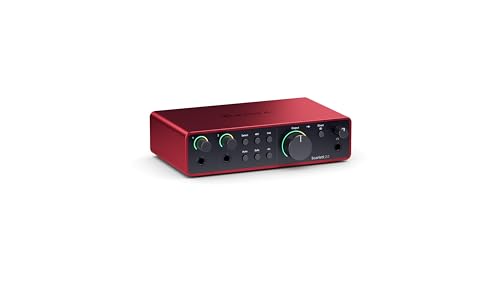
Focusrite Scarlett 2i2 4th Gen USB-C Audio Interface
Included for 'Best Audio Interfaces for Recording and Streaming' as a relevant option in this category; details come from the product listing.
View on Amazon
Focusrite Scarlett Solo 3rd Gen USB-C Audio Interface
Included for 'Best Audio Interfaces for Recording and Streaming' as a relevant option in this category; details come from the product listing.
View on Amazon
M-AUDIO M-Track Duo USB Audio Interface
Included for 'Best Audio Interfaces for Recording and Streaming' as a relevant option in this category; details come from the product listing.
View on AmazonBest audio interfaces at a glance
| Interface | Mic inputs | Other inputs | Outputs | Headphone capability | Typical market range |
|---|---|---|---|---|---|
| Focusrite Scarlett 4i4 4th Gen | 2 combo mic/line | 2 rear line inputs, MIDI | 4 line outputs, 2 headphone outputs | Two independent headphone mixes; suitable for common studio headphones | Usually $250–$300 |
| MOTU M4 | 2 combo mic/line | 2 rear line inputs, MIDI | 4 line outputs, 1 headphone output | Powerful enough for many 32–80-ohm headphones | Usually $250–$300 |
| Audient iD14 MkII | 2 combo mic/line | ADAT optical input, 1 instrument input | 4 line outputs, 2 headphone connections | Strong output; especially useful with less-sensitive headphones | Usually $300–$400 |
| SSL 2+ | 2 combo mic/line | MIDI | 4 line outputs, 2 headphone outputs | Good dual-headphone monitoring for collaborative recording | Usually $280–$350 |
| Universal Audio Volt 276 | 2 combo mic/line | MIDI | 2 line outputs, 1 headphone output | Good for typical closed-back monitoring headphones | Usually $250–$350 |
| RME Babyface Pro FS | 2 mic/line inputs | ADAT, MIDI, digital I/O | Balanced line outputs, headphone output | Clean, controlled output with excellent monitoring flexibility | Usually $800–$1,000 |
Head-to-head: which interface fits your setup?
Best overall for a gaming laptop: MOTU M4
The MOTU M4 is a particularly strong match for a gaming laptop used for streaming, music, voice chat, and occasional recording. It has two front-facing combo inputs, two additional line inputs, four balanced line outputs, MIDI, and a clear front-panel meter. The extra line inputs let you connect a second stereo device, such as a mixer, synthesizer, or gaming audio source, without immediately needing a larger interface.
Its loopback feature is useful for streaming because it can route computer audio into broadcast software while preserving a separate microphone signal. This is valuable when you need game audio, music, and voice in a stream without depending entirely on software mixers. MOTU’s drivers are also respected for low-latency Windows operation.
Choose the M4 if you want two microphones now, more line connectivity later, and a simple way to monitor both live inputs and computer playback.
Best affordable two-microphone option: Focusrite Scarlett 4i4 4th Gen
The Scarlett 4i4 4th Gen is a flexible choice for a podcast, two-person stream, acoustic instruments, or a gaming desk with separate voice and room microphones. Its two microphone preamps provide up to 69 dB of gain, which is enough for many dynamic microphones that need substantial amplification. The interface also includes two additional line inputs, MIDI, loopback support, and two headphone outputs.
Its Auto Gain and Clip Safe functions can simplify level setting. They are not substitutes for understanding gain staging, but they reduce the chance of a sudden shout clipping a recording. Focusrite Control 2 handles routing and monitoring, and the included software bundle can help new users start recording without assembling every tool separately.
The main limitation is headphone power. It is adequate for most normal studio headphones, but very demanding high-impedance models may sound quieter than they do from a dedicated headphone amplifier.
Best preamps and headphone drive under the premium tier: Audient iD14 MkII
The Audient iD14 MkII is compelling when microphone quality and headphone output matter more than having four analog outputs. Its two console-style mic preamps provide clean gain, while the JFET instrument input is useful for direct guitar or bass recording. The interface also supports an ADAT optical input, allowing an eight-channel digital preamp to expand the system later.
That expansion makes the iD14 a better long-term recording interface than its two mic inputs suggest. For example, you can begin with vocals and guitar, then add an eight-channel ADAT unit for a drum kit or band rehearsal without replacing the main interface.
The iD14 MkII connects over USB-C and can work with compatible iPad setups, though mobile use may require an appropriate powered hub or external power arrangement. Check the tablet, cable, and power requirements before buying if mobile recording is a major priority.
Best for two people monitoring together: SSL 2+
The SSL 2+ is a practical choice for interviews, co-streaming, and collaborative vocal recording because it provides two headphone outputs and two independent microphone inputs. Its 4K-inspired enhancement can add presence and brightness, but it should be used selectively: it may help a dull dynamic microphone, while a sharp voice or already-bright condenser microphone may sound better with it disabled.
The interface has four line outputs, MIDI, and straightforward desktop controls. It is less expandable than an interface with ADAT, but its direct-monitoring layout is easy to understand when two people need to hear the same performance with minimal delay.
Best for character and simple vocal production: Universal Audio Volt 276
The Volt 276 is aimed at users who want a compact interface with a built-in compressor and vintage-style preamp mode. Its two inputs are suitable for vocals, instruments, and basic streaming. The onboard 76-style compressor can make a voice more consistent before it reaches streaming software, which is useful when you do not want to configure a full software dynamics chain.
However, its two outputs and single headphone output make it less convenient for complex monitoring. Choose it for a small, character-focused setup rather than a multi-device streaming workstation.
Best for professional low-latency reliability: RME Babyface Pro FS
The RME Babyface Pro FS costs more, but its appeal is consistent driver performance, extensive routing through TotalMix FX, and support for ADAT expansion. It is suited to musicians and streamers who need dependable monitoring, multiple cue mixes, and a system that can grow beyond a basic two-microphone setup.
Its controls and routing are more complex than those of entry-level interfaces. That complexity is useful once you need separate mixes for a performer, a co-host, and a broadcast computer, but unnecessary if you only record one microphone at a time.
How to choose by input and output requirements
| Your situation | Minimum useful configuration | Good fit |
|---|---|---|
| One microphone and gaming audio | 1 mic preamp, loopback, 1 headphone output | Scarlett Solo 4th Gen or Volt 276 |
| Two microphones for a podcast or co-stream | 2 mic preamps, 2 headphone outputs, independent monitoring | Scarlett 4i4 4th Gen or SSL 2+ |
| Two microphones plus external stereo audio | 2 mic inputs, at least 2 additional line inputs | MOTU M4 |
| Guitar, vocals, and future drum expansion | 2 inputs now, ADAT optical expansion later | Audient iD14 MkII or RME Babyface Pro FS |
| Separate performer and stream mixes | Multiple outputs, flexible software routing, low-latency drivers | RME Babyface Pro FS |
| Phone or tablet recording | Class-compliant USB, adequate bus power, compatible adapter | Scarlett 4i4 4th Gen, MOTU M4, or iD14 MkII after checking power needs |
Preamp quality: what matters in practice
Modern interfaces in this price range generally provide clean preamps. The more important questions are maximum gain, equivalent input noise, and how much gain your microphone needs. A condenser microphone usually needs less gain than a low-output dynamic microphone. If a dynamic microphone requires 60 dB of gain and your interface provides about 55 dB, you may need an inline booster, which adds cost and another connection.
For streaming, clean gain and a stable noise floor are normally more useful than a colored preamp. Built-in saturation or “vintage” modes can be enjoyable, but they should not be the main reason to accept weak routing or insufficient headphone output.
Latency and a useful buffer calculation
Latency is controlled mainly by the driver, sample rate, buffer size, computer load, and plug-ins. At 48 kHz, a 64-sample buffer represents:
64 samples ÷ 48,000 samples per second = 1.33 milliseconds
That is one-way buffer time. A round-trip path through input conversion, software processing, output conversion, and driver safety buffers will be longer—often several milliseconds. Start with a 64-sample buffer for live vocals or instruments, then move to 128 or 256 samples if crackles occur. Larger buffers reduce CPU pressure but increase monitoring delay.
For streaming speech, 128 or 256 samples is usually a sensible compromise. Use direct monitoring when possible for a singer or instrumentalist, but remember that direct monitoring will not include software effects unless the interface’s mixer or onboard DSP provides them.
Desktop and mobile connectivity
For a Windows gaming laptop, prioritize a dedicated manufacturer driver, stable USB operation, and loopback or flexible routing. Plug the interface directly into the laptop rather than through an overloaded hub when troubleshooting dropouts. On macOS, class-compliant operation is common, but routing software still varies by manufacturer.
Mobile recording requires more than a USB-C connector. The phone or tablet must support USB audio, the interface must operate within the device’s available power, and the adapter must permit data and charging where necessary. A powered USB hub is often the reliable solution for bus-powered interfaces. Test the complete cable and power chain before a live mobile broadcast.
Recommended setup settings
- Set the interface and recording software to the same sample rate, normally 48 kHz for streaming video.
- Begin with a 64- or 128-sample buffer for live monitoring; increase it if the laptop produces pops or dropouts.
- Leave vocal peaks around -12 to -6 dBFS while recording. This preserves headroom for unexpected volume changes.
- Use direct monitoring for zero-software-delay vocals, but disable duplicate monitoring in the streaming application to prevent an echo.
- For two microphones, create separate tracks rather than mixing them to one track immediately. This lets you fix different volume and noise levels later.
Bottom line
Choose the MOTU M4 for the most versatile desktop I/O, the Scarlett 4i4 4th Gen for an accessible two-microphone streaming setup, the Audient iD14 MkII for strong preamps and headphone drive with ADAT expansion, and the RME Babyface Pro FS when driver reliability and routing flexibility justify a premium price. The best audio interfaces are not necessarily the ones with the highest sample-rate number; they are the ones that provide enough clean gain, monitoring power, inputs, outputs, and low-latency connectivity for the way you actually record or stream.