Key takeaways
- Solid cooking spoon: Use it for soups, sauces, rice, and stirring. A bowl about 5–7 cm wide is useful without being awkward in a small saucepan.
- Slotted spoon: Slots drain liquid while lifting vegetables, dumplings, or pasta. Rounded slots are easier to clean than very narrow decorative cuts.
- Solid turner: The broad face is useful for pancakes, burgers, roasted vegetables, and scraping fond. A beveled front edge slides under food more easily.
- Slotted turner: Slots let oil or liquid drain when turning fried or sautéed food. Choose a thin but not flimsy leading edge.
- Flat scraper or sauté spatula: A squared edge reaches into pan corners and is useful for risotto, stir-fries, and thick sauces.
The best wooden utensil set for kitchen use is usually a compact set made from hard maple, beech, or teak, with smooth food-safe finishing, a slotted turner, a solid turner, a cooking spoon, a slotted spoon, and a utensil holder that keeps the tools upright and dry.
Quick comparison: which wooden set fits your kitchen?
| Kitchen situation | Best wood choice | Useful utensil shapes | Storage preference | Main trade-off |
|---|---|---|---|---|
| Everyday cooking and lowest maintenance | Beech or hard maple | Solid spoon, angled turner, slotted spoon | Countertop crock | Needs occasional oiling |
| High-moisture cooking and frequent stirring | Teak | Deep spoon, broad turner, slotted spatula | Open rack or ventilated holder | Usually heavier and more expensive |
| Nonstick cookware | Any smooth hardwood | Thin edge turner, fish-style turner, scraper spoon | Drawer insert with ventilation | Thin edges require more careful washing |
| Small kitchen or occasional use | Beech or bamboo | Three- or four-piece essentials set | Wall rail or narrow crock | Bamboo varies widely in glue and finish quality |
| Heavy cast-iron or stainless-steel cookware | Dense maple or teak | Thick solid turner, rigid spoon, flat scraper | Large crock | More durable but less flexible |
Wood species compared
Hard maple: the balanced all-rounder
Hard maple is a strong choice when you want a firm utensil that does not feel excessively heavy. Its relatively fine grain can be sanded smooth, making it comfortable for scraping the bottom of a pan or folding thick mixtures. Look for a set with rounded edges and no rough end grain around the bowl or handle.

Hefild Wooden Spoons for Cooking, 10-Piece Acacia Wood Cooking Utensil Set
Included for 'Best Wooden Utensil Sets for the Kitchen' because the listing specifies 10-Piece Acacia Wood Cooking Utensil Set, details this guide uses to compare options.
View on Amazon
HSM Wooden Spoons for Cooking, 10-Piece Acacia Wood Kitchen Utensil Set
Included for 'Best Wooden Utensil Sets for the Kitchen' because the listing specifies 10-Piece Acacia Wood Kitchen Utensil Set, details this guide uses to compare options.
View on Amazon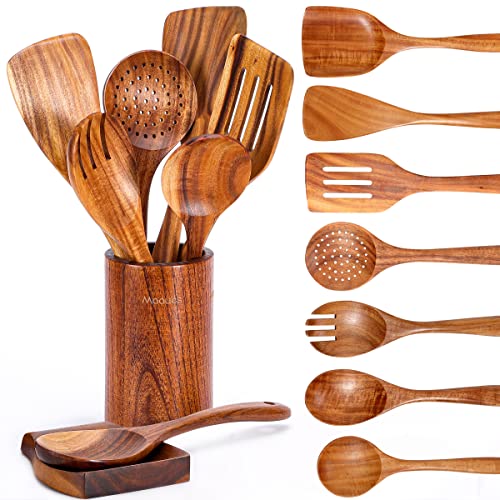
Mooues Wooden Kitchen Utensil Set, 9 Piece Natural Teak with Spoon Rest
Included for 'Best Wooden Utensil Sets for the Kitchen' because the listing specifies 9 Piece Natural Teak with Spoon Rest, details this guide uses to compare options.
View on Amazon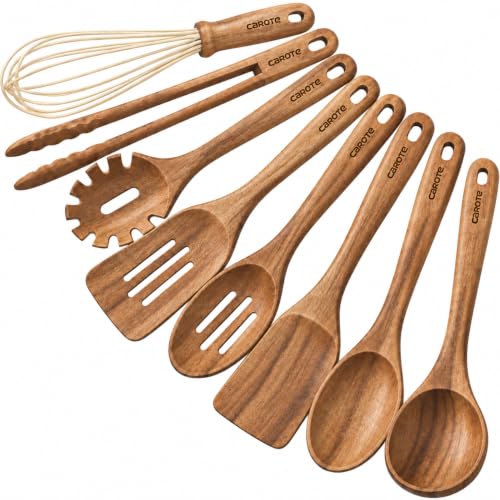
CAROTE Wooden Utensil Set, 8-Piece Acacia Wood Cooking Utensils
Included for 'Best Wooden Utensil Sets for the Kitchen' because the listing specifies 8-Piece Acacia Wood Cooking Utensils, details this guide uses to compare options.
View on AmazonMaple is not waterproof. It tolerates normal cooking moisture but should not be left soaking in a sink. It is particularly suitable for cooks who want one versatile set for sauces, vegetables, eggs, and general stirring.
Beech: good value and easy to shape
Beech is commonly used for wooden kitchen tools because it is hard enough for regular cooking, reasonably light, and easy to form into thin spatulas and broad turners. A well-finished beech utensil can be excellent value.
The quality difference between beech sets is often more noticeable than the difference between beech and maple. A poorly sanded handle, sharp corner, or thin split-prone edge matters more than the species name. Choose beech when the set has a smooth finish and you prefer lighter tools.
Teak: naturally moisture-resistant, but not maintenance-free
Teak contains natural oils that help it resist moisture better than many lighter woods. That makes it appealing for cooking tools exposed to sauces, soups, and repeated washing. It also tends to feel dense and substantial.
Teak still requires hand-washing and drying. Its natural oil content does not make it dishwasher-safe or immune to cracking. If sustainability matters, look for clear information about responsibly sourced teak rather than assuming that a teak label guarantees it.
Bamboo: light, inexpensive, and construction-dependent
Bamboo is technically a grass, but it is sold alongside wooden utensils. It is light and often inexpensive, though many bamboo utensils are laminated from several strips. Inspect the joints: visible gaps, lifting layers, or a strong chemical odor are reasons to choose another set.
Bamboo can work well for occasional cooking, but dense solid-wood tools are often more satisfying for scraping and heavy stirring. Prioritize the finish and construction over the word “bamboo” on the packaging.
Utensil shapes matter more than set size
A large set is not automatically more useful. For most kitchens, five carefully chosen shapes cover nearly every task:
- Solid cooking spoon: Use it for soups, sauces, rice, and stirring. A bowl about 5–7 cm wide is useful without being awkward in a small saucepan.
- Slotted spoon: Slots drain liquid while lifting vegetables, dumplings, or pasta. Rounded slots are easier to clean than very narrow decorative cuts.
- Solid turner: The broad face is useful for pancakes, burgers, roasted vegetables, and scraping fond. A beveled front edge slides under food more easily.
- Slotted turner: Slots let oil or liquid drain when turning fried or sautéed food. Choose a thin but not flimsy leading edge.
- Flat scraper or sauté spatula: A squared edge reaches into pan corners and is useful for risotto, stir-fries, and thick sauces.
Optional tools such as a fork, pasta server, honey dipper, or miniature spoon are worthwhile only if you use them. A six-piece set with two different turners is often more practical than a twelve-piece set filled with duplicates.
Finish quality and heat resistance
Wooden utensils are safe for normal stovetop cooking because wood is a poor heat conductor, but “heat-resistant” does not mean “leave it in the pan.” The wood can scorch, the finish can dry out, and the handle can become hot if it rests against a hot pan wall.
Do not use a wooden utensil as a permanent substitute for a high-temperature grill tool. Keep it away from direct flames, glowing burners, broilers, and empty pans heating at maximum power. A darkened tip, blistered coating, smoke smell, or rough raised grain means the tool should be retired or carefully refinished rather than continuing in food.
For finish quality, check four areas:
- The handle should feel smooth without splinters or a sharp seam.
- The bowl and turner edge should have a continuous curve, not a jagged transition.
- The grain should not contain deep cracks, open knots, or loose fibers near the working end.
- The surface should look even without a thick, peeling film. A penetrating food-safe oil finish is easier to maintain than a coating that flakes.
Food-safe mineral oil is commonly used for maintenance because it does not go rancid like many cooking oils. Apply a thin coat to clean, completely dry wood, allow it to absorb, and wipe away excess. Beeswax-based board creams can add water resistance, but they do not eliminate the need for hand-washing.
Storage: the simple calculation many buyers overlook
Storage affects how long wooden utensils last. If a set contains eight tools averaging 3 cm of handle width, placing them tightly in a 10 cm crock creates a crowded bundle with limited airflow. A 14–16 cm crock gives the handles more room and makes it easier to remove one tool without scraping the others.
For a countertop crock, choose one with a stable base and enough depth that at least one-third of each utensil remains supported. A narrow, tall container can tip when a heavy teak turner is removed. For a drawer, use a ventilated insert and leave roughly 1–2 cm between groups of tools so damp surfaces are not pressed together.
Wall rails save counter space, but the utensils must hang from a smooth hole or loop that does not trap water inside the handle. Never store a wooden tool while it is still wet.
Hand-washing routine that prevents cracking
- Rinse promptly: Remove sauce, starch, and grease before they dry onto the grain.
- Wash briefly: Use warm water, mild dish soap, and a soft sponge. Avoid prolonged soaking.
- Clean the edges: Pay attention to slots, end grain, and the joint between handle and working end.
- Dry immediately: Wipe the utensil and stand it upright or lay it flat in an airy place.
- Inspect weekly: Run a clean fingertip over the surface. Roughness, a hairline split, or a loose laminated layer is an early warning.
- Oil when dry: Apply food-safe mineral oil when the wood looks pale, feels dry, or absorbs water unusually quickly.
Dishwashers combine heat, strong detergent, and repeated wet-dry cycles. That combination can warp wood, open joints, and strip its protective oil. Even if a manufacturer describes a utensil as dishwasher-tolerant, hand-washing is the safer long-term choice.
How to choose the best set for your budget
In the usual market, basic bamboo or beech sets cost about $15–$30, better-finished hardwood sets commonly fall around $25–$60, and premium teak or larger sustainably sourced sets often run about $45–$100 or more. Price is less important than grain quality, edge shaping, and a useful selection of tools.
For most buyers, the strongest choice is a five- or six-piece hard maple, beech, or teak set containing a solid spoon, slotted spoon, solid turner, slotted turner, and scraper. Select beech for lighter weight and value, maple for an all-purpose balance, or teak for a denser feel and better moisture tolerance. Whichever species you choose, smooth finish quality, sensible storage, and consistent hand-washing will have more effect on service life than adding extra utensils.