Key takeaways
- VRAM capacity: Aim for at least 6GB, and prefer 8GB if your budget allows, since modern game textures and higher resolutions eat memory fast.
- Resolution target: Match the card to your monitor; 1080p cards handle esports and most AAA titles well, while 1440p needs more headroom.
- Power and PSU compatibility: Check the recommended power supply wattage and connector type before buying, especially with older RX 580 cards that draw more power for their performance tier.
- Upscaling support: Features like DLSS or FSR can significantly extend a budget card’s usable life by boosting frame rates without a major quality hit.
- Port and slot fit: Confirm your case has clearance for 2 to 2.5-slot coolers and that your display outputs (HDMI, DisplayPort) match your monitor’s inputs.
What's inside
Building or upgrading a gaming PC without overspending on the graphics card is one of the trickiest parts of the process. GPU prices swing wildly, marketing specs can be misleading, and it’s easy to overpay for features you won’t actually use at 1080p or 1440p. The gap between “budget” and “worth buying” has also narrowed in 2026, with newer architectures trickling down to entry-level price points.
This guide cuts through the noise and breaks down the best budget graphics cards available right now, from proven RTX 3050 options to RX 580 workhorses and the newer RTX 5060. We’ll cover what actually matters when shopping on a budget, review the top picks in detail, and answer the questions we hear most from buyers building their first (or next) budget gaming rig.
As an Amazon Associate we earn from qualifying purchases at no extra cost to you. Product prices and availability are accurate as of the date shown and are subject to change.




🎮 Get More From Your Setup — Free
Prime Gaming gives you free PC games every month, in-game loot, and a free Twitch channel sub — plus fast free shipping on all the gear above. New members get a 30-day free trial.
Watch: Best Budget Gaming Card — Video Review
How to Choose a Budget Gaming Card (2026)
- VRAM capacity: Aim for at least 6GB, and prefer 8GB if your budget allows, since modern game textures and higher resolutions eat memory fast.
- Resolution target: Match the card to your monitor; 1080p cards handle esports and most AAA titles well, while 1440p needs more headroom.
- Power and PSU compatibility: Check the recommended power supply wattage and connector type before buying, especially with older RX 580 cards that draw more power for their performance tier.
- Upscaling support: Features like DLSS or FSR can significantly extend a budget card’s usable life by boosting frame rates without a major quality hit.
- Port and slot fit: Confirm your case has clearance for 2 to 2.5-slot coolers and that your display outputs (HDMI, DisplayPort) match your monitor’s inputs.
The Best Budget Gaming Card (2026)s Reviewed
MSI RTX 3050 Ventus 2X 6G OC
The Ventus 2X delivers dependable 1080p performance with the efficiency and ray-tracing support of NVIDIA’s Ampere architecture, making it a smart pick for gamers moving on from integrated graphics. Its compact dual-fan cooler and modest power draw make it an easy drop-in for tighter builds.
ASUS Dual RTX 3050 OC Edition
ASUS pairs the RTX 3050 with its Axial-tech fan design and a reinforced steel bracket, resulting in a card that runs cooler and feels more durable than most budget options. The 3-year warranty adds real peace of mind for a card meant to last several GPU generations.
Kelinx AISURIX RX 580 8GB
With a full 8GB of GDDR5 and a 256-bit bus, this RX 580 punches above its price class in older and less demanding modern titles. It’s a strong choice for buyers prioritizing VRAM capacity over cutting-edge features like ray tracing.
MOUGOL RX 580 8GB White
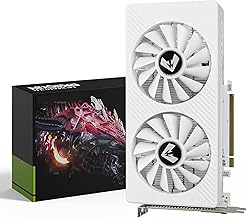
This RX 580 variant matches the AISURIX on core specs while adding a clean white shroud and triple video outputs, making it a solid fit for themed builds. Dual-fan cooling keeps temperatures reasonable under sustained load in mid-range cases.
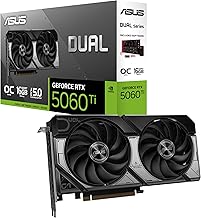
ASUS Dual RTX 5060 8GB GDDR7 OC
The RTX 5060 is the clear step-up pick here, bringing PCIe 5.0, DLSS 4, and quiet 0dB idle operation to the budget segment. It costs more than the RX 580 and RTX 3050 options, but its newer architecture and 8GB of GDDR7 make it the better long-term investment for 1440p gaming.
Frequently Asked Questions
Is the RTX 3050 or RX 580 better for a budget build in 2026?
The RTX 3050 offers ray tracing and DLSS upscaling that the older RX 580 lacks, making it the more future-proof choice, while the RX 580’s larger 8GB VRAM pool can help in a handful of memory-heavy older titles.
How much power supply do I need for these cards?
Most RTX 3050 and RTX 5060 cards run comfortably on a 450 to 550W PSU, while RX 580 cards typically need closer to 500W due to their higher power draw relative to performance.
Can a budget card handle 1440p gaming?
The RTX 5060 handles 1440p reasonably well, especially with DLSS enabled, but the RTX 3050 and RX 580 are better suited to 1080p for consistently smooth frame rates.
Do I need DLSS or FSR on a budget card?
Yes, upscaling support meaningfully extends a budget GPU’s lifespan by boosting frame rates in demanding titles, which is why the DLSS 4 support on the RTX 5060 is a notable advantage.
Final Thoughts
For most 1080p builders, the ASUS Dual RTX 3050 OC Edition offers the best balance of cooling, warranty, and modern features, while the Kelinx AISURIX RX 580 8GB remains a value pick for buyers who prioritize VRAM over ray tracing. If your budget stretches further, the ASUS Dual RTX 5060 8GB GDDR7 OC is the smartest long-term upgrade thanks to its newer architecture and DLSS 4 support.