Key takeaways
- Match the shape to your grip: Palm grippers want a taller, filled-out hump like the DeathAdder or G502; claw and fingertip players are usually happier with something shorter and lighter such as the G305. Shape is the one thing software can’t fix, so get it right first.
- Ignore max DPI, look at the sensor: Almost every mouse here tracks flawlessly at the 400–1600 DPI most competitive players actually use. What matters is a modern optical sensor with no smoothing or acceleration — not whether it advertises 8,000 or 30,000 DPI.
- Weight beats RGB: Under 90g feels noticeably quicker in shooters, especially at low sensitivity where you’re making big arm sweeps. Heavier mice aren’t disqualified, but you should be getting something in return, like extra buttons or a tuned weight system.
- Wireless is finally viable at this price: A good 2.4GHz dongle-based connection is genuinely indistinguishable from wired for the vast majority of players. Avoid Bluetooth-only budget models for gaming — the latency is real and you will feel it.
- Check switch durability and warranty: Look for rated switches in the 50–90 million click range and onboard memory so your settings survive without background software. A two-year warranty is standard from the major brands and worth insisting on.
What's inside
Shopping for a gaming mouse under $50 is genuinely harder than it looks. The budget tier is crowded with lookalike shells wrapped around wildly different sensors, switches, and software, and marketing copy loves to shout about 26,000 DPI numbers that no human being will ever use. Meanwhile the specs that actually decide whether you win a duel — click latency, sensor consistency at your real tracking speed, weight distribution, and whether the shape suits your grip — rarely make it onto the box.
This guide cuts through that. Below you’ll find our picks for the best gaming mice you can buy for under $50 in 2026, spanning wireless, wired, ergonomic, and MMO-friendly options. Every recommendation here sits comfortably within budget at typical street pricing, and each one earns its spot on real-world performance rather than spec-sheet theatre. We’ll also cover what to prioritise at this price, answer the questions we get asked most, and finish with the picks we’d hand to a friend.
As an Amazon Associate we earn from qualifying purchases at no extra cost to you. Product prices and availability are accurate as of the date shown and are subject to change.




⚡ Save on Your Next PC — Amazon Prime
Prime members get fast free shipping on the systems above, plus early access to Prime Day & Black Friday PC deals. New members get a 30-day free trial.
Watch: Best Gaming Mouse Under $50 — Video Review
How to Choose Gaming Mouse Under $50
- Match the shape to your grip: Palm grippers want a taller, filled-out hump like the DeathAdder or G502; claw and fingertip players are usually happier with something shorter and lighter such as the G305. Shape is the one thing software can’t fix, so get it right first.
- Ignore max DPI, look at the sensor: Almost every mouse here tracks flawlessly at the 400–1600 DPI most competitive players actually use. What matters is a modern optical sensor with no smoothing or acceleration — not whether it advertises 8,000 or 30,000 DPI.
- Weight beats RGB: Under 90g feels noticeably quicker in shooters, especially at low sensitivity where you’re making big arm sweeps. Heavier mice aren’t disqualified, but you should be getting something in return, like extra buttons or a tuned weight system.
- Wireless is finally viable at this price: A good 2.4GHz dongle-based connection is genuinely indistinguishable from wired for the vast majority of players. Avoid Bluetooth-only budget models for gaming — the latency is real and you will feel it.
- Check switch durability and warranty: Look for rated switches in the 50–90 million click range and onboard memory so your settings survive without background software. A two-year warranty is standard from the major brands and worth insisting on.
The Best Picks Reviewed
Logitech G305 Lightspeed
Still the benchmark for affordable wireless, the G305 pairs Logitech’s Lightspeed connection with the excellent HERO sensor and runs for months on a single AA battery. At roughly 99g it isn’t the lightest option anymore, but the latency, tracking, and build quality are effectively flagship-grade for the money.
Logitech G502 Hero
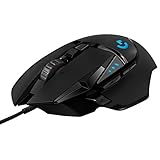
The G502 remains the most feature-dense mouse in the budget bracket, with eleven programmable buttons, a free-spin scroll wheel, and an adjustable weight system that lets you tune the feel. It’s a heavy, sculpted mouse built for palm grip and productivity-plus-gaming duty rather than twitch-focused FPS play.
Redragon M612
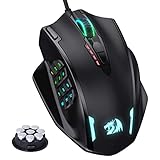
The M612 is the value pick that keeps surprising us: 8000 DPI optical tracking, fully remappable keys, RGB lighting, and a lightweight shell for a fraction of what the big brands charge. Software polish and long-term switch feel don’t match Logitech or Razer, but as a first gaming mouse or a spare it’s very hard to argue with.
Razer Basilisk V3
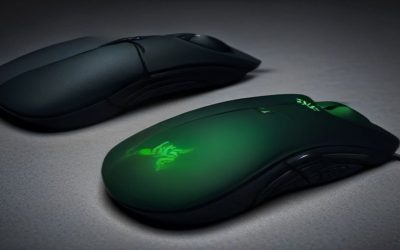
Razer’s Basilisk V3 delivers a genuinely premium experience at the top of this budget, with a superb ergonomic shape, optical switches, and a smart scroll wheel that switches between tactile and free-spin modes. The paddle-style sniper button and eleven-zone lighting make it feel like a mouse that should cost considerably more.
Razer DeathAdder Essential
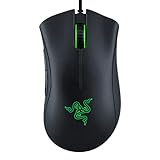
The DeathAdder shape has sold tens of millions of units for good reason, and the Essential distils it down to a reliable 6,400 DPI sensor, five buttons, and a comfortable right-handed shell. There’s no wireless and no frills, but for palm-grip players who want proven ergonomics on a tight budget it’s close to a default recommendation.
Frequently Asked Questions
Is a wireless gaming mouse under $50 actually good enough for competitive play?
Yes, provided it uses a dedicated 2.4GHz dongle rather than Bluetooth. Logitech’s Lightspeed implementation in the G305 has been used at the professional level, and the difference in click-to-screen latency versus a wired equivalent is measured in fractions of a millisecond.
How much DPI do I really need?
Far less than you think. Most competitive FPS players sit between 400 and 1600 DPI with low in-game sensitivity, so any mouse here has an order of magnitude more range than you’ll use. Higher DPI is only genuinely useful on 4K monitors or for fast desktop navigation.
Does mouse weight matter that much?
It matters more than RGB, polling rate, or DPI ceiling. Lighter mice reduce fatigue during long sessions and make flick shots feel snappier, which is why the sub-90g category exploded. That said, some players prefer the stability and control of a heavier mouse, so it’s worth trying both if you can.
Will these mice work on Mac, Linux, or console?
All of them will function as standard USB or wireless mice on any modern operating system, and most work on consoles that support mouse input. Configuration software is generally Windows-first, so save your settings to onboard memory before switching platforms.
Final Thoughts
If you want one recommendation, make it the Logitech G305 Lightspeed — it’s the rare budget mouse with no meaningful compromises, and cutting the cord at this price still feels like a small luxury. Palm-grip players and anyone who wants maximum features for the money should look at the Razer Basilisk V3 or the Logitech G502 Hero, both of which punch well above the $50 mark in build quality and customisation. Whichever you choose, buy for shape and comfort first; every mouse on this list has a sensor good enough to stop being the reason you lost the round.