Key takeaways
- Footprint: TKL is roughly 20% narrower, freeing desk space and letting your keyboard and mouse sit closer together for better ergonomics.
- Mouse room: Without a numpad, TKL gives low-sensitivity gamers far more room for wide sweeping aim movements before hitting the board.
- Number entry: Full-size keeps a dedicated numpad for fast data entry and calculator work, which TKL sacrifices entirely.
- Ergonomics: TKL lets you center your typing area with your monitor and keep your mouse arm in a more natural, shoulder-friendly position.
- Portability: TKL boards are lighter and shorter, making them easier to carry to LAN events or slot into a bag; full-size boards are bulkier.
- Familiarity: Full-size requires zero adjustment since it matches most office keyboards, while TKL users occasionally miss the numpad at first.
What's inside
Full-size versus tenkeyless (TKL) is the keyboard layout question that quietly defines your entire desk setup in 2026. A full-size board packs everything — function row, arrows, and a dedicated number pad — into one familiar 104-key slab, while a TKL board like the Logitech G PRO or Corsair K70 CORE TKL drops the numpad to reclaim precious desk space and pull your mouse hand closer to home.
This choice matters more than it sounds. It affects your gaming posture, your desk ergonomics, how much room your mouse has for wide low-sensitivity swings, and whether you can crunch numbers without reaching for a separate pad. With strong TKL options like the HyperX Alloy Origins Core and Razer Huntsman V3 Pro alongside classic full-size layouts, the right pick in 2026 depends on how you split your time between gaming, work, and everything in between.
As an Amazon Associate we earn from qualifying purchases at no extra cost to you. Product prices and availability are accurate as of the date shown and are subject to change.


⚡ Save on Your Next PC — Amazon Prime
Prime members get fast free shipping on the systems above, plus early access to Prime Day & Black Friday PC deals. New members get a 30-day free trial.
Watch: Full-Size vs TKL Keyboard: 2026 Comparison — Video Review
Quick Verdict
Choose a TKL keyboard like the Corsair K70 CORE TKL or Razer Huntsman V3 Pro if you game a lot, use a low mouse sensitivity, or want a cleaner, more ergonomic desk. Pick full-size if you regularly enter numbers — spreadsheets, accounting, data entry — and value having every key in its traditional place without adopting a separate numpad.
Key Differences
- Footprint: TKL is roughly 20% narrower, freeing desk space and letting your keyboard and mouse sit closer together for better ergonomics.
- Mouse room: Without a numpad, TKL gives low-sensitivity gamers far more room for wide sweeping aim movements before hitting the board.
- Number entry: Full-size keeps a dedicated numpad for fast data entry and calculator work, which TKL sacrifices entirely.
- Ergonomics: TKL lets you center your typing area with your monitor and keep your mouse arm in a more natural, shoulder-friendly position.
- Portability: TKL boards are lighter and shorter, making them easier to carry to LAN events or slot into a bag; full-size boards are bulkier.
- Familiarity: Full-size requires zero adjustment since it matches most office keyboards, while TKL users occasionally miss the numpad at first.
Full-Size Keyboards: Complete and Productivity-Ready
Full-size keyboards remain the productivity champion because they give you every key you could reach for without compromise. The dedicated number pad is a genuine speed tool for anyone working in spreadsheets, accounting software, POS systems, or data entry, where a numpad can double input speed compared with the top-row number keys. Nothing has to be remapped or relearned, since the 104-key layout matches the office keyboards most people grew up on.
For gamers who also work from the same desk, or households where one PC does double duty, the full-size layout avoids the daily friction of a missing numpad. If your workflow leans on numbers even part of the time, keeping that block in its standard position is more valuable than the desk space you would save by dropping it, making full-size the safe all-rounder for mixed use.
TKL Keyboards: Compact, Ergonomic, and Gamer-Favored
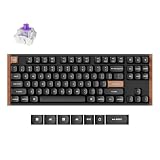
TKL keyboards have become the enthusiast and gamer default by cutting the one section many players rarely touch: the numpad. Removing it shrinks the board by about a fifth, and that reclaimed space does two important things — it lets you pull your mouse in closer for a more natural arm angle, and it gives low-sensitivity players like the ones drawn to the Logitech G413 TKL SE or SteelSeries Apex 3 TKL much more room for big aim swings without slamming into the keyboard.
The compact form is also a portability and aesthetics win. A TKL board like the HyperX Alloy Origins Core is easy to toss in a bag for a LAN party and looks tidier on a minimal desk. For anyone whose main use is gaming, or who simply never touches a numpad, TKL delivers better ergonomics and a cleaner setup with almost no downside.
Which Should You Buy?
- For competitive FPS gaming: pick TKL because the extra mouse room supports low-sensitivity aiming and better arm ergonomics.
- For spreadsheet and data-entry work: pick full-size so the dedicated numpad keeps your number crunching fast and comfortable.
- For a small or shared desk: pick TKL to reclaim width and keep your keyboard and mouse closer together.
- For LAN and portable setups: pick TKL like the Corsair K55 CORE TKL since it is lighter and easier to transport.
- For a single do-everything office and gaming PC: pick full-size to avoid ever missing a key during work tasks.
Frequently Asked Questions
Do professional gamers use TKL or full-size?
The majority of competitive players use TKL or smaller, because dropping the numpad gives their mouse more room for low-sensitivity movements and centers the board for healthier posture.
Will I miss the numpad on a TKL keyboard?
It depends on your workflow. If you rarely enter numbers you likely will not notice, but if you use spreadsheets or accounting tools daily, the missing numpad can be a real slowdown.
Is a TKL keyboard better for ergonomics?
For most people, yes. A narrower board lets you position your mouse closer to center, keeping your arm in a more natural angle and reducing shoulder strain during long sessions.
Can I add a numpad to a TKL keyboard later?
Yes. A separate wireless or wired numpad lets you keep the compact TKL benefits while adding number entry only when you need it, and you can place it on either side of the keyboard.
Final Verdict
In 2026, TKL keyboards are the better pick for gamers and anyone chasing a cleaner, more ergonomic desk, thanks to the extra mouse room and compact footprint that models like the Razer Huntsman V3 Pro exploit so well. Full-size still rules for number-heavy work where the dedicated pad earns its space every day — so match the layout to how often your fingers actually reach for that numpad.