Key takeaways
- Ray tracing: NVIDIA holds a clear lead in ray-traced performance and is the choice for maxing out those effects.
- Upscaling and frame gen: NVIDIA’s DLSS is the most refined; AMD’s FSR is more open and widely compatible but slightly less polished.
- VRAM: AMD often provides more video memory at a given price, helpful for high-resolution and heavily modded games.
- Raw performance per dollar: AMD frequently wins in traditional rasterized games at each price tier.
- Software features: NVIDIA offers extras like Reflex, Broadcast, and strong creator-app support.
- Power efficiency: varies by generation and model, so check the specific cards you are comparing.
Your graphics card is the single most important component in a gaming PC, and the choice between NVIDIA and AMD shapes everything from your frame rate to your feature set to the price you pay. In 2026 both companies make genuinely great GPUs, but they emphasize different strengths: NVIDIA leads on ray tracing and AI-driven features, while AMD counters with strong raw performance per dollar and generous video memory. Choosing well means matching those strengths to how you actually play.
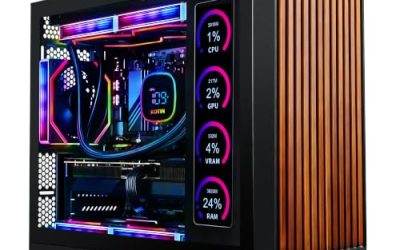
This comparison lays out the practical differences that matter to gamers, ray tracing, upscaling and frame generation, VRAM, power, and value, so you can decide with confidence. Whether you are configuring a system around an RTX-equipped machine like the iBUYPOWER Element or a ZOTAC MEK desktop with a flagship card, or weighing an AMD Radeon build, this guide focuses on the trade-offs that affect your gaming, not marketing slides.
Our top picks



As an Amazon Associate we earn from qualifying purchases at no extra cost to you. Ratings are shown as listed on Amazon.
⚡ Save on Your Next PC — Amazon Prime
Prime members get fast free shipping on the systems above, plus early access to Prime Day & Black Friday PC deals. New members get a 30-day free trial.
Watch: NVIDIA vs AMD GPUs in 2026 — Video Review
Quick Verdict
NVIDIA is the safe pick for gamers who want the best ray tracing, the most mature upscaling and frame generation (DLSS), and top-tier features, usually at a price premium. AMD (Radeon) is the value champion, typically offering more raw rasterization performance and more VRAM per dollar, which is great for high-resolution gaming on a budget. If you prioritize cutting-edge features and ray tracing, go NVIDIA; if you want the most frames per dollar in traditional rendering, go AMD.
Key Differences
- Ray tracing: NVIDIA holds a clear lead in ray-traced performance and is the choice for maxing out those effects.
- Upscaling and frame gen: NVIDIA’s DLSS is the most refined; AMD’s FSR is more open and widely compatible but slightly less polished.
- VRAM: AMD often provides more video memory at a given price, helpful for high-resolution and heavily modded games.
- Raw performance per dollar: AMD frequently wins in traditional rasterized games at each price tier.
- Software features: NVIDIA offers extras like Reflex, Broadcast, and strong creator-app support.
- Power efficiency: varies by generation and model, so check the specific cards you are comparing.
The Case for NVIDIA
NVIDIA’s advantage is its feature ecosystem. DLSS upscaling and frame generation are the most mature in the industry, delivering big smoothness gains with excellent image quality, and NVIDIA’s ray tracing hardware is simply faster, letting you enable heavy RT effects that bring AMD cards to their knees. Prebuilts like the iBUYPOWER Element and ZOTAC MEK pair these GPUs with strong CPUs for a turnkey experience.
Beyond gaming, NVIDIA leads in creator and AI workloads, so if you stream, edit video, or dabble in AI tools, its cards and software (Reflex, Broadcast, CUDA support) add real value. That broad capability is why NVIDIA commands a premium and why many buyers happily pay it.
The Case for AMD
AMD Radeon’s pitch is straightforward: more frames and more memory for your money in traditional rendering. At most price points an AMD card matches or beats its NVIDIA rival in rasterized games, the vast majority of what people play, and its extra VRAM ages gracefully as games grow more memory-hungry, especially at 1440p and 4K.
AMD’s FSR upscaling and frame generation are open technologies that work across a wide range of hardware, and the gap to DLSS has narrowed considerably. For gamers who want maximum performance without paying the ray tracing premium, an AMD Radeon build stretches a budget further while still delivering a superb high-refresh experience.
Which Should You Buy?
- Choose NVIDIA if ray tracing, the best upscaling/frame generation, and creator features top your list.
- Choose AMD Radeon if you want the most raw frames and VRAM per dollar in traditional games.
- Choose NVIDIA if you stream or do content creation alongside gaming.
- Choose AMD for high-resolution gaming on a budget where extra memory helps.
- Whichever you pick, make sure your PSU has the right connector and wattage, high-end cards demand clean, ample power.
Frequently Asked Questions
Is NVIDIA always better than AMD?
No. NVIDIA leads in ray tracing and features, but AMD frequently wins on raw rasterization performance and VRAM per dollar. The better card depends on your budget and whether you prioritize cutting-edge effects or maximum traditional frame rate.
Does more VRAM matter for gaming?
Increasingly, yes. Modern games at 1440p and 4K with high textures can use a lot of video memory, and running short causes stutter and forced setting reductions. AMD’s typically larger VRAM buffers are an advantage for future-proofing at higher resolutions.
Can I use an AMD GPU with an Intel CPU?
Absolutely. GPU and CPU brands are independent, so any modern NVIDIA or AMD graphics card works with any modern Intel or AMD processor. Choose each component on its own merits without worrying about cross-brand compatibility.
Is DLSS or FSR better?
DLSS generally has a slight edge in image quality and refinement, while FSR is more open and works on a broader range of GPUs, including competitors’ cards. Both dramatically improve frame rates, and the difference is small enough that it rarely decides a purchase alone.
Final Verdict
NVIDIA and AMD both make excellent gaming GPUs in 2026, so the right choice is about priorities. Pick NVIDIA for the best ray tracing, upscaling, and creator features; pick AMD for the most raw performance and memory per dollar. Decide how you actually play, match the card to a suitable CPU and power supply, and you will be thrilled either way.