Key takeaways
- Peak gaming performance: AMD’s 3D V-Cache X3D processors lead in most games, sometimes by double-digit percentages in CPU-bound titles.
- Platform longevity: AMD’s AM5 socket is supported for years of future CPU upgrades; Intel tends to change sockets more often.
- Value in prebuilts: Intel Core i5 and i7 systems frequently appear in well-priced prebuilt gaming PCs and bundles.
- Power and heat: AMD X3D chips run efficiently, while high-end Intel parts can draw more power and demand stronger cooling.
- Productivity: Intel and AMD trade blows depending on the app, with high-core AMD parts strong in multithreaded work.
- Integrated graphics: both offer capable iGPUs now, useful for troubleshooting or light gaming without a discrete card.
The Intel versus AMD debate is the oldest rivalry in PC gaming, and in 2026 it is closer and more interesting than ever. Both companies make excellent gaming processors, but they take different paths to get there, and the right choice depends heavily on your budget, whether you also stream or create content, and how much you care about platform longevity. Picking the wrong side can mean overpaying or leaving frames on the table.
This comparison cuts through the fanboy noise to give you a practical, gamer-focused breakdown of how Intel and AMD stack up right now: raw gaming frame rates, value at each price tier, power and heat, and the upgrade path each platform offers. Whether you are eyeing a Ryzen-based system, an Intel prebuilt, or a mini PC like the GMKtec M5 Ultra, this guide will help you spend your money where it actually matters for gaming.
Our top picks


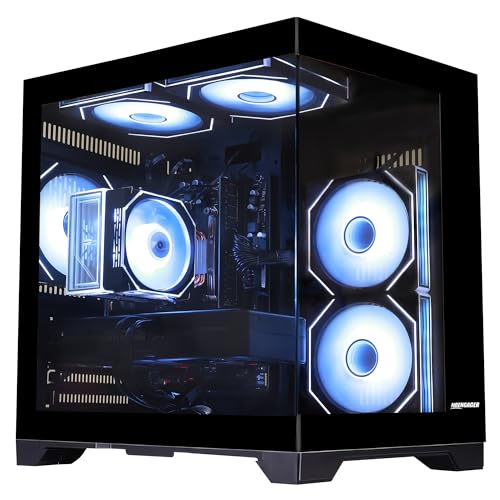


As an Amazon Associate we earn from qualifying purchases at no extra cost to you. Ratings are shown as listed on Amazon.
⚡ Save on Your Next PC — Amazon Prime
Prime members get fast free shipping on the systems above, plus early access to Prime Day & Black Friday PC deals. New members get a 30-day free trial.
Watch: Intel vs AMD for Gaming in 2026 — Video Review
Quick Verdict
For pure gaming, AMD’s X3D chips with their massive 3D V-Cache currently hold the frame-rate crown and are the enthusiast’s pick, while also offering a longer upgrade path on the AM5 socket. Intel counters with strong all-round performance, often better value in prebuilts and midrange bundles, and superior productivity in some professional apps. If gaming is your top priority and you want the best frames per dollar over time, AMD edges it; if you want a great-value complete system today, Intel is very competitive.
Key Differences
- Peak gaming performance: AMD’s 3D V-Cache X3D processors lead in most games, sometimes by double-digit percentages in CPU-bound titles.
- Platform longevity: AMD’s AM5 socket is supported for years of future CPU upgrades; Intel tends to change sockets more often.
- Value in prebuilts: Intel Core i5 and i7 systems frequently appear in well-priced prebuilt gaming PCs and bundles.
- Power and heat: AMD X3D chips run efficiently, while high-end Intel parts can draw more power and demand stronger cooling.
- Productivity: Intel and AMD trade blows depending on the app, with high-core AMD parts strong in multithreaded work.
- Integrated graphics: both offer capable iGPUs now, useful for troubleshooting or light gaming without a discrete card.
The Case for AMD
AMD’s headline advantage for gamers is 3D V-Cache. Chips like the Ryzen 7 7800X3D and its successors stack extra cache directly on the die, which games love, translating into higher frame rates and better 1% lows in CPU-limited scenarios. That is why AMD dominates the high-refresh, competitive gaming conversation.
The AM5 platform also gives AMD a longevity edge. Buy an AM5 motherboard now and you can likely drop in a much faster CPU years later without replacing the board, a real money-saver for anyone who upgrades incrementally. AMD systems, from full desktops to compact mini PCs like the GMKtec M5 Ultra, span a wide range of budgets.
The Case for Intel
Intel’s strength is well-rounded performance and value in complete systems. Core i5 processors like the i5-14400F deliver excellent gaming frame rates at a lower price than the top X3D chips, and they show up constantly in attractively priced prebuilts such as Intel 12th/14th Gen towers paired with modern GPUs.
Intel also tends to lead in certain productivity and single-threaded workloads, and its platform is mature and widely supported. If you want a capable gaming machine that also handles everyday multitasking and creative apps well, without paying the premium for a flagship gaming CPU, an Intel build is an easy, sensible recommendation.
Which Should You Buy?
- Choose AMD X3D if maximum gaming frame rate and future upgradeability are your top priorities.
- Choose Intel Core i5 if you want the best value in a complete gaming system or prebuilt right now.
- Choose AMD AM5 if you plan to upgrade the CPU in a few years without replacing the motherboard.
- Choose Intel if you mix gaming with productivity apps where its all-round performance shines.
- Either brand is a great choice; match the CPU to a GPU worthy of it, since the graphics card matters more for most games.
Frequently Asked Questions
Is AMD really faster than Intel for gaming?
At the very top end, AMD’s X3D chips generally lead in gaming benchmarks thanks to their large cache. In the midrange the two are much closer, and a well-chosen Intel Core i5 games beautifully. The GPU usually matters more than the CPU brand for frame rate.
Does the CPU brand affect which GPU I can use?
No. Both Intel and AMD processors work with any modern NVIDIA or AMD graphics card. You can pair an Intel CPU with an AMD GPU or vice versa without any issue, so choose each component on its own merits.
Which platform lasts longer for upgrades?
AMD’s AM5 socket currently offers the longer upgrade runway, letting you swap in newer CPUs on the same motherboard for several generations. Intel historically changes sockets more frequently, often requiring a new board for a major CPU jump.
Do I need an X3D chip to game well?
Not at all. X3D chips are the fastest for gaming, but a midrange Intel or AMD processor delivers excellent frame rates in the vast majority of titles. X3D matters most for competitive players chasing very high frame rates on a strong GPU.
Final Verdict
Both Intel and AMD build outstanding gaming CPUs in 2026, so there is no wrong answer, only the right answer for your priorities. Go AMD X3D for the gaming performance crown and long upgrade life; go Intel for excellent value in a ready-to-play system. Whichever you pick, invest the savings in a capable GPU, because for most games that is what truly determines your frame rate.