Key takeaways
- Table of Contents 7 sections 10 min read 1 Quick Verdict 2 Side by Side 3 Where 16GB Wins 4 Where 24gb Laptop Ram Wins 5 Cost Over 5 Years 6 Which One for Your Home 6.1 Small apartment 6.2…
What's inside
Choosing between 16GB and 24GB of laptop RAM is less about buying the biggest number and more about matching the computer to your household. The real decision is whether you want a practical laptop for everyday work, streaming, school, and light creative tasks—or extra headroom for many browser tabs, photo and video projects, virtual machines, and a longer usable life.
For most homes, 16GB remains a comfortable starting point. However, 24GB can be a sensible upgrade when the price difference is modest or when the laptop’s memory is soldered and cannot be expanded later. In 2026, the best choice depends on the laptop’s processor, storage, screen, battery, and upgrade design as much as the RAM capacity itself.
As an Amazon Associate we earn from qualifying purchases at no extra cost to you. Product prices and availability are accurate as of the date shown and are subject to change.



Quick Verdict
Choose 16GB RAM if you primarily browse the web, use Microsoft Office or Google Workspace, stream video, attend video calls, manage photos, and play mainstream games. It is enough for most people and often keeps the laptop’s price, power use, and heat under control.
Choose 24GB laptop RAM if you regularly keep 20 or more browser tabs open, work with large spreadsheets, edit photos or 1080p video, use demanding creative software, or want more breathing room for the next five years. It is also attractive when the laptop has soldered memory, since you cannot add RAM later.
One important distinction: RAM is temporary working memory, while an SSD or USB flash drive stores files permanently. A 16GB flash drive does not make a laptop equivalent to a laptop with 16GB of RAM. For example, the Enfain 16GB USB 2.0 Flash Drive 10 Pack costs $35.99, while a comparable 16GB Flash Drive 10 Pack with LED indicators is listed at $35.88. Those products are useful for transferring documents and photos, but they do not increase laptop performance in the same way installed RAM does.
Side by Side
| Factor | 16GB RAM | 24GB RAM |
|---|---|---|
| Comfort | Comfortable for everyday work, school, streaming, and normal multitasking | More comfortable with heavy multitasking and demanding applications |
| Performance feel | Fast when paired with a modern processor and SSD | Less likely to slow down when several large apps are open |
| Price range | Commonly about $450-$900 for mainstream models | Commonly about $500-$1,100, depending on processor and build |
| Maintenance | May require closing apps or upgrading sooner on a fixed-memory laptop | Requires less memory management over time |
| Space needed | Usually available in compact 13- to 15-inch laptops | Often found in 15- to 16-inch models, though compact options exist |
| Look and portability | More choices under 4 pounds and roughly 0.6-0.8 inches thick | Can be equally slim, but higher-capacity configurations are often heavier |
| Resale | Easy to sell as a mainstream configuration | May appeal to power users and improve usefulness later |
| Best for | General home use, school, office work, and casual gaming | Creative work, technical tasks, heavy multitasking, and longer ownership |
| Upgrade value | Good if the RAM is removable and inexpensive to expand | Especially valuable when the memory is soldered and fixed |
Where 16GB Wins
Sixteen gigabytes offers the strongest balance for a typical household. A laptop with 16GB can handle a dozen or more browser tabs, a video call, music playback, a word processor, and cloud storage without constant slowdowns—assuming it also has a reasonably current processor and an SSD.
It is particularly well suited to a shared family computer. One person can use a browser and email while another prints homework, streams a show, or edits a basic presentation. For elementary and high school assignments, budgeting, shopping, telehealth appointments, and streaming services, 16GB is generally sufficient.
Sixteen gigabytes can also be the better gaming configuration when the savings go toward a stronger processor or graphics card. RAM alone does not determine frame rates. A laptop with 16GB, a fast SSD, and capable graphics may feel much faster in games than a 24GB laptop with a weak processor.
Portability is another advantage. Mainstream 16GB laptops are widely available in 13.3-, 14-, and 15.6-inch sizes. A 14-inch model may weigh approximately 3 to 3.5 pounds, while a 15.6-inch model often falls between 3.5 and 4.5 pounds. If the laptop moves from a kitchen counter to a sofa or home office every day, choosing a lighter model may matter more than an extra 8GB of memory.
Finally, 16GB often leaves more budget for a 512GB or 1TB SSD, a brighter display, a better webcam, or a larger battery. Those upgrades can make everyday ownership more pleasant than extra RAM that you rarely use.
Where 24gb Laptop Ram Wins
The main benefit of 24GB is headroom. When your open applications need more memory than the laptop has available, the system temporarily relies on the SSD. That process is much slower than using RAM, so the computer may feel sluggish when switching between apps. Twenty-four gigabytes reduces the chance of reaching that limit.
This capacity makes sense for people who keep many tabs and programs open for hours. A household manager might have several shopping tabs, a spreadsheet, email, a video call, accounting software, and photo folders open simultaneously. A college student or remote worker may also appreciate the extra margin when running communication apps alongside research tools.
Creative users benefit more clearly. Large photo libraries, layered image files, music projects, and 1080p or 4K video timelines can consume substantial memory. Twenty-four gigabytes is not a replacement for a strong processor, discrete graphics, or a fast SSD, but it can make multitasking smoother while those programs are running.
It is also useful for technical work. Developers running local servers, containers, emulators, or a virtual machine can use 24GB more comfortably than 16GB. If you plan to keep a laptop for five years and cannot upgrade its RAM, paying for additional capacity now may be cheaper than replacing the entire computer early.
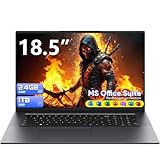
There are already broad price differences between individual models. The BWPED 18.5-inch laptop is listed at $499.99 with 24GB RAM and a 1TB SSD, while the Lenovo V-Series V15 business laptop is listed at $989 with 24GB RAM and a 1TB SSD. Those examples show why shoppers should compare the complete specification sheet rather than assuming every 24GB laptop is expensive. Check the processor generation, display resolution, battery size, keyboard, warranty, and memory configuration before deciding.
Cost Over 5 Years
Over five years, the purchase-price difference is only part of the calculation. A mainstream 16GB laptop may cost roughly $450-$900, while a 24GB model may range from about $500-$1,100. The gap can be less than $100 when the manufacturer offers 24GB as a configuration option, but it can be much larger when additional RAM comes bundled with a premium processor, display, or business chassis.
If the laptop has removable RAM, a 16GB model may be the economical choice. You could later add an 8GB module for approximately $25-$50, or a compatible 16GB module for approximately $35-$80, although installation and compatibility vary. Confirm the number of slots, maximum supported capacity, and whether the existing memory is soldered before relying on this strategy.
If the memory is soldered, the decision is more permanent. Paying $50-$150 extra for 24GB at purchase can be reasonable if it postpones replacement by even a year. Conversely, paying hundreds more solely for RAM may not be worthwhile if the laptop has a slow processor, a dim 1366-by-768 display, or a small 256GB SSD.
Also budget for a protective sleeve, accidental-damage coverage if appropriate, and eventual battery replacement. Laptop batteries commonly lose noticeable capacity after several years, and replacement pricing can range from about $80 to $200 depending on the model. A well-built 16GB laptop can outlast a cheaply built 24GB laptop.
Which One for Your Home
Small apartment
Choose 16GB for a compact apartment or studio where the laptop doubles as the primary entertainment and work device. A 14-inch laptop weighing around 3 to 3.5 pounds is easy to store in a drawer or move between a small table and couch. Put the savings toward a 1TB SSD, a comfortable external keyboard, or a monitor if you work at home regularly.
Family with kids or pets
Sixteen gigabytes is usually the practical family choice, especially if the computer will be used for homework, streaming, printing, and casual gaming. Look for a sturdy hinge, spill-resistant keyboard, a good warranty, and a screen with at least 300 nits of brightness. Choose 24GB if several family members will share the laptop for heavier tasks or if replacement would be difficult in the next five years.
Rental
For a rental home, prioritize portability and flexibility. A 16GB laptop with a 14- or 15.6-inch display is easy to move and less costly to replace if your work location changes. A USB-C dock can add a monitor, keyboard, and wired network connection without requiring a large desktop setup. Consider 24GB if the laptop is your only work computer and you run demanding software away from an office.
Long-term home
For a permanent home office or a laptop you expect to keep for five years or more, 24GB is the safer capacity when the price premium is reasonable. It provides more room for software updates and increasingly complex websites. Still, favor a quality build, 512GB or 1TB SSD, modern Wi-Fi, and a replaceable battery over a large RAM number on a poorly designed laptop.
FAQ
Is 24GB RAM noticeably better than 16GB?
It is noticeably better when your workload exceeds 16GB or comes close to it. For basic browsing, documents, and streaming, the difference may be difficult to feel. Heavy multitasking, creative applications, and virtual machines are more likely to benefit.
Is 16GB enough for a laptop in 2026?
Yes, 16GB remains enough for most home, school, and office tasks. Pair it with a modern processor and SSD, and avoid choosing a laptop with only 4GB or 8GB if you want several years of comfortable use.
Can I upgrade a 16GB laptop to 24GB later?
Sometimes. A laptop with removable memory may accept an additional 8GB module, but many thin models use soldered RAM. Check the manufacturer’s service manual and maximum supported capacity before buying.
Does more RAM improve battery life?
Not automatically. More RAM can reduce slow storage swapping, but battery life depends heavily on the processor, display brightness, battery watt-hours, software, and wireless use. Compare the complete laptop design rather than expecting 24GB alone to extend runtime.