Key takeaways
- Refresh rate: A 120Hz or 144Hz panel is the single biggest upgrade for cloud gaming; it makes fast titles feel fluid where a 60Hz screen looks choppy.
- Processor: An Intel Core i3 or i5 keeps ChromeOS, the browser, and the video decode pipeline responsive. MediaTek chips are fine for lighter use but can stutter under load.
- RAM: Aim for 8GB. Cloud gaming plus a few browser tabs will choke a 4GB machine.
- Display quality: Look for at least 1080p IPS; a 2.5K panel and touch support are welcome bonuses for versatility.
- Connectivity: Wi-Fi 6 or 6E dramatically lowers stream latency and packet loss, which is exactly what cloud gaming needs.
What's inside
Chromebooks used to be shorthand for “email machine,” but cloud gaming rewrote the rules. With services like GeForce NOW and Xbox Cloud Gaming streaming AAA titles straight to a browser, a well-specced Chromebook with a fast display can deliver a genuinely great gaming experience—no discrete GPU required. The trick is knowing which specs actually matter when the heavy lifting happens in a data center.
We focused on the three things that make or break cloud gaming on ChromeOS: a high-refresh screen, a snappy processor for the OS and browser, and enough RAM to keep tabs and game streams smooth. Here’s how to choose, followed by the models that stood out.
As an Amazon Associate we earn from qualifying purchases at no extra cost to you. Product prices and availability are accurate as of the date shown and are subject to change.




🎮 Get More From Your Setup — Free
Prime Gaming gives you free PC games every month, in-game loot, and a free Twitch channel sub — plus fast free shipping on all the gear above. New members get a 30-day free trial.
Watch: Best Gaming Chromebook — Video Review
How to Choose a Gaming Chromebook
- Refresh rate: A 120Hz or 144Hz panel is the single biggest upgrade for cloud gaming; it makes fast titles feel fluid where a 60Hz screen looks choppy.
- Processor: An Intel Core i3 or i5 keeps ChromeOS, the browser, and the video decode pipeline responsive. MediaTek chips are fine for lighter use but can stutter under load.
- RAM: Aim for 8GB. Cloud gaming plus a few browser tabs will choke a 4GB machine.
- Display quality: Look for at least 1080p IPS; a 2.5K panel and touch support are welcome bonuses for versatility.
- Connectivity: Wi-Fi 6 or 6E dramatically lowers stream latency and packet loss, which is exactly what cloud gaming needs.
The Best Gaming Chromebooks Reviewed
ASUS Chromebook Vibe CX34 Flip
Purpose-built for cloud gaming, the Vibe CX34 Flip pairs a 14-inch 144Hz touch display with a Core i5 and a convertible hinge. That fast panel is the headline: streamed games look smooth, and the stylus and flip form factor add real flexibility for media and note-taking.
Acer Chromebook Plus Spin 514
A 2-in-1 with a Core i5-1334U, 8GB of RAM, and a generous 512GB SSD, the Spin 514 is the most well-rounded pick here. The backlit keyboard and touchscreen make it a comfortable daily driver, and the horsepower handles browser gaming and productivity without complaint.
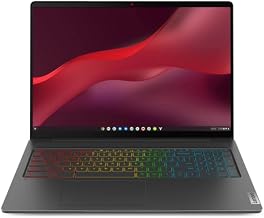
Lenovo IdeaPad 5 Gaming Chromebook
The standout feature is its 16-inch 2.5K display—the sharpest, most immersive canvas in this group. Paired with a Core i3-1215U and 8GB of RAM, it’s ideal for players who want screen real estate and resolution over raw touch versatility.
Acer Chromebook Plus 515 (Touch)
A 15-inch FHD touchscreen with a Core i3 and 8GB of RAM makes this a spacious, comfortable option for cloud gaming on the couch. The larger chassis also means better speakers and a roomier keyboard for long sessions.
Lenovo Kompanio Chromebook
The budget entry, this 14-inch FHD touch model runs an 8-core MediaTek Kompanio 520. With 4GB of RAM it’s best for lighter cloud titles and casual play, but its long battery life and low price make it an easy on-ramp to Chromebook gaming.
Frequently Asked Questions
Can you actually game on a Chromebook?
Yes—through cloud services. GeForce NOW, Xbox Cloud Gaming, and Amazon Luna stream full PC and console games to the browser, so the Chromebook just needs a fast screen and solid Wi-Fi rather than a GPU.
How much RAM do I need?
8GB is the sweet spot for cloud gaming plus everyday browsing. 4GB works for a single light game stream but struggles once you open multiple tabs.
Does refresh rate really matter for cloud gaming?
Absolutely. A 120Hz or 144Hz panel makes streamed action games feel dramatically smoother than a standard 60Hz display, assuming your connection can keep up.
Do I need the internet the whole time?
For cloud gaming, yes—a stable, low-latency connection is essential. Android games installed locally can run offline, but the streamed AAA experience depends on staying online.
Final Thoughts
For dedicated cloud gamers, the ASUS Chromebook Vibe CX34 Flip’s 144Hz screen is the pick to beat. If you want the best all-arounder, the Acer Chromebook Plus Spin 514 balances power, storage, and versatility beautifully, while the Lenovo IdeaPad 5 wins on sheer display quality with its 16-inch 2.5K panel.