
Key takeaways
- A “gaming” label with no dedicated GPU and no clear explanation of expected game performance.
- Only 8GB of RAM when the memory cannot be upgraded.
- A 128GB or 256GB drive, which can fill quickly after installing school software and several games.
- Peak processor speeds used as the main performance claim, with no core count or cooling information.
- A 17-inch laptop with a small battery and a very heavy power adapter.
- No stated brightness, refresh rate, warranty length, or return policy.
- Only one USB port, especially if you need a mouse, headset, external drive, or presentation adapter.
What's inside
Shopping for a gaming laptop as a college student is less about buying the biggest specifications sheet and more about avoiding expensive mismatches. A machine that looks powerful may have a weak cooling system, short battery life, a dim display, or a weight that becomes frustrating after a week of carrying it across campus. Another common mistake is treating any laptop with “gaming” in its name as a true gaming computer. Some affordable models use integrated graphics and are better suited to schoolwork and light games, while demanding modern titles require a dedicated graphics card.
This gaming laptop buying guide for college students focuses on the details that affect daily use: portability, performance, durability, screen quality, total cost, and support. Prices and component availability can change, but the following framework will help you compare models intelligently in 2026 without paying for specifications you will not use.
As an Amazon Associate we earn from qualifying purchases at no extra cost to you. Product prices and availability are accurate as of the date shown and are subject to change.


Decide These 3 Things First
- What games will you play? Esports games such as Valorant, Rocket League, and Fortnite are much easier to run than graphically intensive single-player games. Decide whether you need integrated graphics, an entry-level dedicated GPU, or a higher-performance gaming GPU.
- How often will you carry it? A 15- or 16-inch laptop weighing 5.5 pounds may be reasonable for occasional transport but tiring for daily classes. Students who commute should prioritize a 13- to 15-inch display and a weight near 4.5 pounds or less.
- What is your complete budget? Include a mouse, headset, backpack, external storage, and possibly a monitor. Reserve at least $50 to $150 for accessories, or more if you need a mechanical keyboard and cooling stand.
Size and Portability
Screen size affects both usability and transportation. A 14-inch laptop is usually the best compromise for students who move between a dorm, library, and classroom. It can provide enough room for split-screen notes and a game while fitting comfortably in most laptop sleeves. A 15.6-inch model offers a more immersive display and often better cooling, but it may weigh between 4.5 and 6.5 pounds. Seventeen-inch laptops can provide a spacious gaming experience, yet they are generally better for desk use than commuting.
Check the complete dimensions, not just the diagonal screen measurement. A laptop measuring roughly 14 by 9 inches is easier to fit into a standard backpack than one closer to 16 by 11 inches. Also note the power brick. A large charger can add another 1 to 2 pounds to your daily load.
Battery capacity is listed in watt-hours (Wh). For school use, look for at least 50Wh; 70Wh or more is preferable on a performance laptop. Gaming away from an outlet typically reduces battery life substantially, so treat battery estimates as productivity guidance rather than gaming promises.
Materials and Build Quality
Most affordable gaming laptops use a plastic chassis, which is not automatically a problem. Good plastic can reduce weight and cost while remaining sturdy enough for campus use. Look for a lid that does not flex dramatically when opened from one corner, a keyboard deck that stays firm under pressure, and hinges that open smoothly without wobbling.
Aluminum or aluminum-plastic construction often feels more substantial, but material alone does not guarantee durability. A metal laptop may still have a fragile hinge or a sharp-edged underside. Inspect the warranty terms and return policy, and read owner feedback for recurring hinge, keyboard, or charging-port complaints.
For regular travel, aim for a chassis with a thickness of about 0.8 to 1.1 inches and a weight below 5 pounds when possible. A protective sleeve with at least 5 to 10 millimeters of padding is worthwhile, especially if the laptop will share a backpack with textbooks.
Construction and Cooling
Gaming performance depends on sustained cooling, not just the processor’s advertised peak speed. Look for separate intake and exhaust vents, a rigid bottom panel, and enough clearance for airflow. Avoid using a performance laptop on a bed or soft blanket, where fabric can block the vents.
Fan noise is normal during gaming. What matters is whether the laptop maintains reasonable performance without frequent stutters or shutdowns. A laptop with two fans and multiple heat pipes will often have more cooling capacity than a thin model with a single small fan, although design quality varies.
Pay attention to upgrade access. A laptop with two memory slots may allow you to move from 16GB to 32GB later, while a model with soldered memory may not. Ideally, the storage drive should be a replaceable M.2 NVMe SSD. A 512GB drive is usable, but modern games can consume 80GB to 150GB each, making a 1TB drive more practical.
Comfort and Performance
For college work, 16GB of RAM should be your baseline. It is enough for web research, video calls, documents, coding tools, and moderate multitasking. Choose 32GB if you use virtual machines, edit video, work with large design files, or want more headroom for future games.
Processor names need context. A recent six- or eight-core processor is generally a stronger long-term choice than a low-power entry-level chip, even if both claim similar clock speeds. Do not compare only “up to” GHz figures; sustained performance, core count, cooling, and graphics hardware matter more.
Integrated graphics, such as Radeon 680M-class graphics, can handle many esports and older games at sensible settings. A dedicated graphics processor is the better choice for modern AAA games. For a smooth general-purpose experience, look for a 1080p display with a refresh rate of at least 120Hz or 144Hz. Check brightness as well: 300 nits is a useful target for rooms with daylight, while 250 nits can look dull near windows.
Keyboard comfort is important for both essays and games. Look for full-size arrow keys, comfortable key travel, and a backlight. Confirm whether the laptop includes a number pad, since that can shift the keyboard position and affect ergonomics. A 1080p webcam is preferable for classes and interviews, though webcam quality remains inconsistent across budget models.
Price Tiers
$300 to $500: school-first laptops. This tier usually includes integrated graphics, 8GB or 16GB of RAM, and a 256GB or 512GB SSD. It is appropriate for coursework, streaming, browser games, and lighter esports titles. For example, an i3-based 15.6-inch work laptop around $329.99 or an Intel N150 model near $399.99 may be sensible student computers, but they should not be marketed as high-end gaming machines.
$500 to $800: balanced entry gaming. This range may include a stronger processor, 16GB of RAM, a 512GB or 1TB SSD, and either capable integrated graphics or an entry-level dedicated GPU. A Ryzen 7430U model priced around $559.99 can be attractive for school and light gaming, but confirm its graphics hardware before buying.
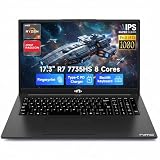
$800 to $1,200: serious student gaming. Expect better cooling, higher-refresh displays, more storage, and a dedicated graphics card in many models. A laptop around $799.99 with a Ryzen 7 7735HS, 16GB of DDR5 memory, 1TB storage, and Radeon 680M graphics may be a strong all-purpose option, but it remains different from a dedicated-GPU gaming laptop.
$1,200 and above: performance-focused systems. This tier is most useful for students who need demanding 3D games, content creation, engineering software, or a high-resolution display. Do not spend this much unless you will use the additional graphics performance; premium materials alone do not improve frame rates.
Warranty and Support
A one-year limited warranty is common, but read what it covers. Accidental drops and liquid damage are often excluded. If you are carrying the laptop daily, an accidental-damage plan may be worth considering when it costs roughly 10% to 20% of the laptop’s purchase price.
Check whether the manufacturer provides phone or chat support, where repairs are performed, and whether the battery has a separate, shorter warranty period. Keep the receipt and record the serial number. Before the return window closes, test every port, the webcam, speakers, charger, keyboard, display, Wi-Fi, and sleep-and-wake behavior.
Delivery and Setup
Laptops do not require furniture-style assembly, but delivery and initial setup still deserve attention. Buy from a seller with a clearly stated return window, ideally at least 30 days. Photograph the shipping box before opening if the package arrives damaged, and do not discard the packaging until you have completed testing.
During setup, install operating-system and manufacturer updates, remove unwanted trial software, and create a recovery drive. Confirm that the charger has the correct wattage; a USB-C charger may support basic charging but not full gaming performance. A laptop stand that raises the rear by 1 to 2 inches can improve airflow, while a cooling pad is optional rather than mandatory.
Spec Checklist
| Spec | Budget | Mid | Premium |
|---|---|---|---|
| Typical price | $300–$500 | $500–$900 | $900–$1,500+ |
| Display | 14–15.6 in., 1080p, 60–120Hz | 14–16 in., 1080p, 120–165Hz | 15–17 in., 1440p or 1080p, 165–240Hz |
| Processor | Modern entry-level 4–6 cores | 6–8 performance-oriented cores | 8 or more strong cores |
| Graphics | Integrated graphics | Strong integrated or entry dedicated GPU | Dedicated gaming GPU |
| Memory | 8–16GB | 16GB | 16–32GB |
| Storage | 512GB SSD | 512GB–1TB NVMe SSD | 1TB–2TB NVMe SSD |
| Weight | 3.5–5 pounds | 4–6 pounds | 4.5–7 pounds |
Red Flags
- A “gaming” label with no dedicated GPU and no clear explanation of expected game performance.
- Only 8GB of RAM when the memory cannot be upgraded.
- A 128GB or 256GB drive, which can fill quickly after installing school software and several games.
- Peak processor speeds used as the main performance claim, with no core count or cooling information.
- A 17-inch laptop with a small battery and a very heavy power adapter.
- No stated brightness, refresh rate, warranty length, or return policy.
- Only one USB port, especially if you need a mouse, headset, external drive, or presentation adapter.
FAQ
Is an integrated-graphics laptop good enough for college?
Yes, if your priorities are writing, research, streaming, video calls, and lighter games. Integrated graphics are less suitable for demanding new games at high settings. Choose 16GB of RAM and a 512GB SSD or larger for a better everyday experience.
Should a college student buy a 14-inch or 15.6-inch laptop?
Choose 14 inches for frequent travel and 15.6 inches for a larger workspace and potentially stronger cooling. Compare actual weight, thickness, battery capacity, and charger size rather than relying on screen size alone.
How much RAM and storage do I need?
Buy at least 16GB of RAM and 512GB of SSD storage. Move to 32GB and 1TB if you play large games, edit media, use engineering applications, or plan to keep the laptop for several years.
Can I use a gaming laptop for classes and lectures?
Absolutely, but portability and battery life may be weaker than on a regular student laptop. Use a balanced power mode for notes and browsing, carry the charger when needed, and consider a lighter 14-inch model if you spend many hours away from an outlet.




