
Key takeaways
- 40–55 Wh: lightest and often found in smaller or budget models; suitable for schoolwork and web browsing, but limited for gaming.
- 56–75 Wh: a practical middle range for 14- to 16-inch gaming laptops.
- 76–99.9 Wh: the largest capacity commonly permitted in a laptop designed for air travel; better for unplugged productivity, though gaming power draw can still drain it quickly.
What's inside
- Decide These 3 Things First
- Battery Capacity: Compare Watt-Hours First
- Size and Weight: Check the Chassis, Not Just the Screen
- Material and Construction: Favor Certified Lithium-Ion Packs
- Comfort and Performance: Match Capacity to the Power Profile
- Price Tiers: Pay for Compatibility Before Capacity
- Warranty: Look for Coverage on Both Parts and Safety
- Delivery and Assembly: Verify Before You Open the Laptop
- Spec Checklist
- Red Flags
- FAQ
Choosing a gaming laptop battery is less about finding the biggest number on the label and more about matching capacity to the laptop’s power demands. A battery rated at 7,000 mAh may sound impressive, but milliamp-hours alone do not tell you how long the computer will run. Voltage, watt-hours, processor power, graphics hardware, screen size, battery age, and charging behavior all matter.
- Decide These 3 Things First
- Battery Capacity: Compare Watt-Hours First
- Size and Weight: Check the Chassis, Not Just the Screen
- Material and Construction: Favor Certified Lithium-Ion Packs
- Comfort and Performance: Match Capacity to the Power Profile
- Price Tiers: Pay for Compatibility Before Capacity
- Warranty: Look for Coverage on Both Parts and Safety
- Delivery and Assembly: Verify Before You Open the Laptop
- Spec Checklist
- Red Flags
- FAQ
Shoppers commonly make three mistakes. First, they compare mAh ratings from different laptops without checking voltage. Second, they assume a larger battery will fit a specific chassis. Third, they buy a replacement based only on a model name, even though one laptop family may use several battery connectors and shapes.
As an Amazon Associate we earn from qualifying purchases at no extra cost to you. Product prices and availability are accurate as of the date shown and are subject to change.


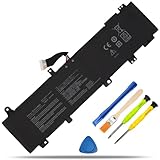
This guide explains how to choose gaming laptop battery size in 2026, whether you are buying a new machine or replacing a worn-out pack. The goal is practical battery capacity, not an inflated specification that adds weight without delivering useful gaming time.
Decide These 3 Things First
- Are you buying a laptop or a replacement battery? A new laptop’s battery is selected by the manufacturer. A replacement must match the exact battery part number, connector, dimensions, mounting points, and voltage.
- Do you need gaming performance or unplugged endurance? A high-performance gaming laptop with a discrete GPU can draw 100 to 250 watts during demanding play. A battery may last only one to two hours under that load, regardless of its advertised capacity.
- How much weight and charging time can you accept? A battery around 50 to 70 Wh is common in portable gaming laptops. Larger 80 to 99.9 Wh packs can improve everyday runtime but add weight and may charge more slowly.
Battery Capacity: Compare Watt-Hours First
Watt-hours, or Wh, are the most useful capacity figure because they combine voltage and charge. The basic calculation is:
Wh = volts × amp-hours
For example, a 15.4-volt battery rated at 4.5 Ah has about 69.3 Wh. A battery labeled 7,000 mAh is 7 Ah, but its actual energy depends on voltage. At 11.4 volts, it equals about 79.8 Wh; at 15.4 volts, it equals about 107.8 Wh. Those are not equivalent batteries, even though both use a 7,000 mAh label.
For most gaming laptops, these ranges are useful:
- 40–55 Wh: lightest and often found in smaller or budget models; suitable for schoolwork and web browsing, but limited for gaming.
- 56–75 Wh: a practical middle range for 14- to 16-inch gaming laptops.
- 76–99.9 Wh: the largest capacity commonly permitted in a laptop designed for air travel; better for unplugged productivity, though gaming power draw can still drain it quickly.
Do not expect a 90 Wh battery to provide nine hours of gaming. At a sustained 100-watt draw, even a theoretical 90 Wh pack would last less than an hour after accounting for conversion losses and reserve capacity.
Size and Weight: Check the Chassis, Not Just the Screen
Battery size is a physical design problem. A 14-inch gaming laptop may use a battery roughly 10 to 12 inches wide and 3 to 5 inches deep, while a 17- or 18-inch model may have room for a longer pack. Exact dimensions vary, so these figures are planning ranges rather than compatibility standards.
Battery weight typically falls between 0.5 and 1.2 pounds. A larger 80- to 99.9-Wh pack may add roughly 0.2 to 0.5 pounds compared with a 45- to 55-Wh unit. The laptop’s total weight matters more: a portable gaming system may weigh 4 to 5.5 pounds, while a larger 17- or 18-inch model can exceed 6 pounds before its charger.
If you are replacing a battery, measure the old pack only as a secondary check. The part number and connector are more important than a similar-looking shape. Never force a battery into place because a few millimeters of difference can interfere with the trackpad, cooling system, or bottom cover.
Material and Construction: Favor Certified Lithium-Ion Packs
Modern gaming laptops normally use lithium-ion or lithium-polymer battery cells. The chemistry is less important to most buyers than the quality of the pack’s construction and control electronics. Look for a rigid casing, neatly insulated wiring, a properly seated connector, and a battery-management system that monitors temperature, voltage, and overcurrent conditions.
Replacement batteries may contain two, three, or more cell groups. A pack’s listed voltage must match the laptop’s required voltage closely; do not substitute a higher-voltage model because it has more watt-hours. The battery should also include protection against overcharging and excessive discharge.
For a new laptop, a battery advertised around 70 to 99.9 Wh is not automatically better if the computer is thick, hot, or heavy. Construction quality also affects heat management. Batteries should not be bent, punctured, swollen, or used if the casing has separated.
Comfort and Performance: Match Capacity to the Power Profile
Battery life depends heavily on the processor, graphics card, display, brightness, refresh rate, and software settings. A laptop using integrated graphics for documents may draw about 8 to 20 watts. A performance laptop with a dedicated GPU can draw 60 to 150 watts during a game, with some high-power configurations reaching higher levels when the CPU and GPU are both working hard.
For gaming away from an outlet, prioritize an efficient processor, a graphics mode that can disable the discrete GPU, and a display with a sensible refresh rate. A 165Hz or 240Hz panel can consume more power than a 60Hz or 120Hz panel, especially at high brightness. Lowering brightness to around 200 to 300 nits, limiting frame rates, and using an energy-saving mode can extend runtime, but these changes reduce performance.
Expect a 60- to 80-Wh battery to provide roughly two to six hours of light productivity in a modern gaming laptop, depending on hardware and settings. Gaming runtime is commonly closer to one to two hours. These are planning estimates, not guaranteed test results; manufacturer specifications and real-world reviews should be checked for the exact model.
Price Tiers: Pay for Compatibility Before Capacity
For a new gaming laptop, budget models generally cost about $600 to $900 and often use 45- to 70-Wh batteries. A larger 18.5-inch gaming laptop listed at $659.99 with a 7,000 mAh battery illustrates why the full specification matters: confirm its voltage, watt-hours, processor, graphics solution, and actual dimensions before comparing it with a smaller machine.
Midrange laptops usually cost $900 to $1,500 and more often include 60- to 90-Wh batteries, improved charging systems, and better performance-per-watt. Premium systems commonly cost $1,500 to $3,000 or more and may combine a 80- to 99.9-Wh battery with a high-power CPU and GPU. That does not guarantee long gaming sessions unplugged.
Replacement batteries are much less expensive. Compatible listings may range from about $25 to $70. Examples include a $32.29 replacement marketed for several ASUS FX and TUF models, a $51.97 pack for an ASUS TUF Gaming A15 FA506IV, and a $24.97 battery for selected HP Omen 17 systems. The low price is useful only if the exact part number and specifications match.
Warranty: Look for Coverage on Both Parts and Safety
A new laptop should include at least a one-year limited warranty. Some premium models provide longer coverage, but battery warranties may be shorter or subject to a reduced-capacity threshold. Read the battery language carefully: “wear item” can limit replacement eligibility.
For a replacement battery, seek at least six to 12 months of coverage and a clear return policy. The seller should identify the supported part numbers, voltage, capacity, connector, and cell type. Avoid listings that promise a capacity far above the original without explaining how the additional cells fit inside the same enclosure.
Keep the invoice and photograph the battery label before installation. If the pack arrives swollen, cracked, hot, or damaged, do not install or charge it. Contact the seller for a return or disposal procedure.
Delivery and Assembly: Verify Before You Open the Laptop
Replacement batteries are often shipped partially charged, commonly around 30% to 60%, because that is safer for storage and transport. Delivery times may range from two to seven business days for domestic inventory, while special-order or international items can take two to four weeks.
Before ordering, compare the battery’s part number with the label inside the laptop or the manufacturer’s service documentation. Check whether the repair requires a Torx or Phillips screwdriver, a plastic pry tool, and an anti-static workspace. Many batteries are held by four to eight screws, but some laptops require removal of the bottom cover or speakers before the connector is accessible.
If the laptop is under warranty, professional installation may be the safer choice. A repair shop commonly charges about $50 to $150 for labor, depending on access and region. Do not puncture, crush, or throw a lithium-ion battery into household trash.
Spec Checklist
| Spec | Budget | Mid | Premium |
|---|---|---|---|
| Typical laptop price | $600–$900 | $900–$1,500 | $1,500–$3,000+ |
| Battery capacity | 45–70 Wh | 60–90 Wh | 80–99.9 Wh |
| Typical laptop weight | 4–6 lb | 4–6.5 lb | 5–8 lb |
| Light-use battery expectation | About 3–6 hours | About 4–8 hours | About 5–10 hours |
| Gaming battery expectation | About 1–2 hours | About 1–3 hours | About 1–3 hours |
| Replacement battery price | $25–$40 | $40–$60 | $60–$100+ |
Red Flags
- A listing shows only mAh and omits voltage or watt-hours.
- The advertised battery fits an unusually long list of unrelated laptop families.
- The capacity is dramatically higher than the original while the case has identical dimensions.
- The seller does not show a connector, part number, voltage, or clear return policy.
- The pack arrives swollen, cracked, hot, leaking, or with loose wires.
- A seller promises many hours of intensive gaming without identifying the processor, GPU, display, and power settings.
FAQ
Is a higher mAh rating always better?
No. Compare watt-hours, voltage, physical dimensions, connector placement, and battery-management compatibility. A higher mAh figure at a different voltage may not provide more usable energy.
What battery size is best for a gaming laptop?
A 60- to 90-Wh battery is a sensible target for many 14- to 16-inch models. Choose up to 99.9 Wh if unplugged productivity matters more than minimum weight. Capacity alone will not make high-power gaming last all day.
Can I install a larger battery in my gaming laptop?
Only if the manufacturer designed the chassis for that battery and the exact connector, voltage, mounting points, firmware, and dimensions match. Do not modify the case or wiring to make a larger pack fit.
When should a gaming laptop battery be replaced?
Consider replacement when capacity has noticeably declined, the laptop shuts down unexpectedly, charging behavior changes, or the battery becomes swollen. Stop using a swollen or physically damaged battery immediately and arrange safe service or recycling.





