
Key takeaways
- 13- to 14-inch laptops: Choose a compact pad roughly 12 to 13 inches wide and 9 to 10 inches deep.
- 15.6-inch laptops: Choose a medium pad roughly 14 to 16 inches wide and 10 to 12 inches deep.
- 16-inch laptops: Look for a medium-large pad, usually 15 to 16.5 inches wide and 10.5 to 12.5 inches deep.
- 17- to 18-inch laptops: Choose a large pad about 16 to 19 inches wide and 11 to 14 inches deep.
What's inside
The Short Answer
The right cooling pad is usually the same size as your gaming laptop or one size larger. For example, a 15.6-inch laptop generally fits a cooling pad rated for 15.6 to 17 inches, while a 17.3-inch laptop needs a pad rated for at least 17 inches. The important measurement is not the screen diagonal alone: compare your laptop’s actual width and depth with the cooling pad’s usable platform.
As a practical rule, choose a pad with a platform at least 0.5 inch wider and 0.5 inch deeper than the laptop. A small amount of extra space helps with rubber stops, rear hinges, ventilation, and cable routing. Avoid going dramatically larger, however. An oversized pad can be heavy, awkward on a desk, and less stable on your lap.
As an Amazon Associate we earn from qualifying purchases at no extra cost to you. Product prices and availability are accurate as of the date shown and are subject to change.

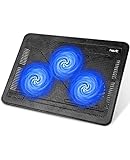

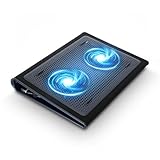
Most gaming laptops fall into these categories:
- 13- to 14-inch laptops: Choose a compact pad roughly 12 to 13 inches wide and 9 to 10 inches deep.
- 15.6-inch laptops: Choose a medium pad roughly 14 to 16 inches wide and 10 to 12 inches deep.
- 16-inch laptops: Look for a medium-large pad, usually 15 to 16.5 inches wide and 10.5 to 12.5 inches deep.
- 17- to 18-inch laptops: Choose a large pad about 16 to 19 inches wide and 11 to 14 inches deep.
Standard Sizes
Cooling-pad sizing is commonly based on laptop screen size, measured diagonally from corner to corner. Since bezels differ, two laptops with the same screen size may have different outside dimensions. Use the table below as a starting point, then verify the exact laptop footprint.
| Laptop size | Typical laptop width | Typical laptop depth | Recommended pad platform | Recommended pad size in inches | Approximate pad size in centimeters |
|---|---|---|---|---|---|
| 13 to 14 inches | 11.5 to 13.0 in | 7.5 to 9.5 in | At least 12.5 by 9.5 in | 12.5 to 14 by 9.5 to 10.5 in | 31.8 to 35.6 by 24.1 to 26.7 cm |
| 15.6 inches | 13.5 to 14.5 in | 9.5 to 10.5 in | At least 14.5 by 10.5 in | 14.5 to 16 by 10.5 to 12 in | 36.8 to 40.6 by 26.7 to 30.5 cm |
| 16 inches | 14.0 to 14.8 in | 9.5 to 10.8 in | At least 15 by 10.5 in | 15 to 17 by 10.5 to 12.5 in | 38.1 to 43.2 by 26.7 to 31.8 cm |
| 17 to 17.3 inches | 15.0 to 16.2 in | 10.0 to 11.5 in | At least 16 by 11 in | 16 to 18.5 by 11 to 13 in | 40.6 to 47.0 by 27.9 to 33.0 cm |
| 18 inches | 16.0 to 16.8 in | 11.0 to 12.0 in | At least 17 by 11.5 in | 17 to 19.5 by 11.5 to 14 in | 43.2 to 49.5 by 29.2 to 35.6 cm |
These are useful buying ranges, not universal laptop measurements. A cooling pad advertised for “15.6 to 17 inches” may have a platform around 16 inches wide, while another may be narrower. Check the manufacturer’s listed width, depth, and maximum supported laptop size before buying.
For reference, a basic 15.6- to 17-inch pad often costs about $25 to $40. Larger RGB models with multiple fans commonly range from $30 to $70. Premium products with automatic fan control, software, metal construction, or quieter fan systems can cost roughly $100 to $150. Examples in these categories include the $27.99 havit HV-F2056, the $33.20 Targus 17-inch Lap Chill Mat, a $34.98 nine-fan ChillCore model, and the $125.99 Razer Laptop Cooling Pad.
How to Measure Your Space
- Measure the laptop’s outside width. Close the laptop and measure from the far-left edge to the far-right edge, including the chassis but not accessories or a mouse. Record the result to the nearest eighth or quarter inch.
- Measure the laptop’s outside depth. Measure from the front edge to the rearmost edge near the hinge. Some gaming laptops have a rear exhaust section that extends beyond the screen, so do not measure only the display panel.
- Check the bottom vents. Note where the intake vents are located. The pad’s fans should sit beneath or close to those openings. A large pad is not useful if its fan positions miss the laptop’s intake areas.
- Add clearance. Add approximately 0.5 inch to the laptop’s width and depth. Add up to 1 inch if the pad has raised front lips, thick rubber feet, or rear supports that reduce the usable surface.
- Measure the desk or lap area. A pad that fits the laptop may still be too large for a narrow desk. Leave room for the power cable and USB cable, and make sure the front edge does not extend uncomfortably past the desk.
- Check the weight and angle. A lightweight pad may weigh 1.5 to 2.5 pounds, while large metal or multi-fan models may weigh 3 to 5 pounds or more. If you type while elevated, look for a firm stop and several angle settings.
- Confirm the connection. Most USB cooling pads draw approximately 1 to 5 watts, depending on fan count and speed. A pass-through USB port is useful, but it may share power with the fans and is not a replacement for a dedicated charger.
By Room or Use Case
Desk gaming setup
For a permanent desk setup, prioritize a stable platform over the smallest possible footprint. A 15.6-inch gaming laptop pairs well with a pad around 15 to 16 inches wide and 11 to 12 inches deep. Look for adjustable height, a front retaining lip, and a rigid base. If the laptop weighs more than 5 pounds, avoid thin, flexible mats that can bow under the chassis.
Small desk or dorm room
Choose a close-fitting pad rather than a universal 17-inch model. For a 14-inch laptop, a pad around 13 by 10 inches saves valuable desk space. Cable placement matters in a compact room, so a side-mounted USB connection can be more convenient than a rear port. A two- or three-fan design is often sufficient when the goal is modest airflow and better desk clearance.
Lap use
A soft lap mat or neoprene design is more comfortable than a rigid gaming stand, but it should still have a firm, ventilated surface. Match the pad closely to the laptop. A 17-inch pad can feel unstable on the lap if the computer is only 14 inches wide. Avoid blocking the pad’s underside with blankets, clothing, or cushions, since restricted intake airflow reduces its usefulness.
Large 17- or 18-inch gaming laptops
Large laptops need more than a matching label. Compare the actual chassis depth, especially if the computer has a thick rear section. Choose a platform at least 16 by 11 inches for many 17-inch models and approximately 17 by 12 inches for many 18-inch models. A broad front stop and a strong hinge are important because large laptops can slide when the pad is tilted.
Common Sizing Mistakes
- Buying by screen size alone: A 15.6-inch label does not tell you the laptop’s exact outside dimensions. Gaming chassis are often thicker and deeper than everyday laptops.
- Choosing a pad that is too small: If the front edge, rear exhaust, or rubber feet hang off the platform, the computer may wobble or sit at an uncomfortable angle.
- Assuming a larger pad always cools better: Fan placement matters more than unused surface area. Align the fans with the laptop’s intake vents.
- Ignoring the raised front lip: A pad can have a generous advertised width but less usable depth once the retaining lip and rear support are considered.
- Forgetting portability: Nine-fan RGB pads may offer broad coverage but can be noisy, heavy, and inconvenient to carry between rooms.
- Overlooking airflow clearance: Leave open space around the pad’s intake vents. Do not place it directly on a soft surface unless it is specifically designed for lap use.
FAQ
What size cooling pad fits a 15.6-inch gaming laptop?
Most 15.6-inch gaming laptops fit a pad rated for 15.6 to 17 inches. Look for a usable platform at least 14.5 inches wide and 10.5 inches deep; a pad around 15 to 16 inches wide by 11 to 12 inches deep is a comfortable target.
Can a 17-inch cooling pad fit a 15.6-inch laptop?
Yes. A 17-inch pad usually works if its front stop holds the smaller laptop securely. Confirm that the laptop does not slide when tilted and that the fans are positioned under the intake vents. The tradeoff is extra size, weight, and desk space.
Should the cooling pad be bigger than the laptop?
Usually, yes, but only slightly. Aim for roughly 0.5 inch of extra width and depth. Up to 1 inch of additional clearance is reasonable for a laptop with a rear hinge extension or a pad with thick supports.
Do more fans require a larger cooling pad?
Not necessarily. Fan count affects the pad’s layout, power use, noise, and price, but not its size by itself. A compact pad with well-placed fans can be a better match than a large nine-fan model whose airflow misses the laptop’s intake vents.


