
Key takeaways
- Confusing wattage with universal compatibility: A 200W adapter is not automatically safe for a laptop designed for 135W. Voltage, amperage, connector dimensions, and polarity must also match.
- Measuring only the adapter housing: The complete charging kit includes the AC cord and output cable, which may add several feet to the packed length and create bulky loops.
- Ignoring connector orientation: A straight connector and a right-angle connector can require very different clearance beside a laptop or wall.
- Buying by laptop series alone: Series names such as Nitro, Victus, Omen, TUF, ROG, and MSI GF do not guarantee one shared adapter specification. Check the exact model number.
- Blocking heat dissipation: A charger squeezed into a sealed drawer can become hotter than one placed in an open, ventilated location. Store it in the drawer only when unplugged and cool.
- Assuming a smaller brick is better: Compact designs may have shorter cables or different output limits. Confirm every electrical specification before prioritizing portability.
What's inside
When shopping for a replacement power brick, the most useful specifications are not just wattage and plug compatibility. The gaming laptop charger dimensions and weight determine whether the adapter fits behind a desk, inside a laptop sleeve, or in a travel bag without adding unnecessary bulk. A 135W charger for an entry-level gaming laptop may be relatively compact, while a 180W or 200W unit usually has a larger housing and heavier cable.
This guide explains typical charger sizes, how much space to reserve, and what to check before buying a replacement. The measurements below are practical shopping ranges based on common gaming laptop AC adapters; individual models can vary by manufacturer and wattage.
As an Amazon Associate we earn from qualifying purchases at no extra cost to you. Product prices and availability are accurate as of the date shown and are subject to change.


The Short Answer
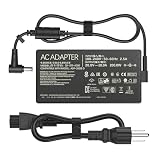
Most gaming laptop power bricks measure approximately 5.0 to 7.5 inches long, 2.0 to 3.5 inches wide, and 1.0 to 1.8 inches thick. In centimeters, that is about 12.7 to 19.1 cm long, 5.1 to 8.9 cm wide, and 2.5 to 4.6 cm thick.
Expect the charger brick itself to weigh roughly 1.0 to 2.2 pounds, or 0.45 to 1.0 kg. Once the AC power cord and DC output cable are included, the complete charging kit commonly weighs 1.5 to 3.2 pounds, or 0.68 to 1.45 kg.
As a general rule, a 135W adapter is often the easiest to carry. Chargers rated at 150W to 180W are moderately bulky, while 200W models need more room in a backpack and may have thicker cables. A compatible replacement should match the laptop’s required voltage, connector size, polarity, and wattage—not just its physical dimensions.
Standard Sizes
The table shows representative size categories for gaming laptop chargers. These are useful planning measurements rather than guaranteed measurements for every product listing. Allow extra room for the cable ends, ventilation, and the bend radius of the cords.
| Charger rating | Typical brick dimensions | Dimensions in centimeters | Brick weight | Complete kit weight | Common use |
|---|---|---|---|---|---|
| 120W–135W | 5.0–6.0 × 2.0–2.8 × 1.1–1.4 in | 12.7–15.2 × 5.1–7.1 × 2.8–3.6 cm | 1.0–1.4 lb | 1.5–2.1 lb | Entry-level gaming laptops and compact systems |
| 150W–180W | 5.8–6.8 × 2.4–3.1 × 1.2–1.6 in | 14.7–17.3 × 6.1–7.9 × 3.0–4.1 cm | 1.3–1.8 lb | 1.9–2.6 lb | Midrange gaming laptops with dedicated graphics |
| 200W | 6.2–7.5 × 2.7–3.5 × 1.3–1.8 in | 15.7–19.1 × 6.9–8.9 × 3.3–4.6 cm | 1.6–2.2 lb | 2.2–3.2 lb | Performance laptops and higher-power GPUs |
For a real-world shopping comparison, a Nivjuky 135W replacement marketed for Acer Nitro 5 laptops falls into the smaller category, although the listing should be checked for its exact housing measurements. Comparable 200W adapters, such as BIYTC models for HP Victus and Omen systems or LIFKAHY models for select Asus TUF and ROG laptops, generally require more desk and bag space. Dongerdi adapters sold in 120W, 150W, and 180W versions illustrate how the wattage can change the physical size even within one product family.
Prices for compatible third-party gaming laptop chargers commonly range from about $25 to $45. The example products listed in this category run from $25.99 to $39.99, but price does not confirm compatibility, safety certification, or actual dimensions. Always compare the seller’s specification panel with the original adapter.
How to Measure Your Space
- Measure the open area, not just the brick. Use a tape measure to record the available length, width, and height under or beside your desk. If the space is 7 inches long, do not buy a brick listed at 7 inches without checking the cable exits.
- Add cable clearance. Reserve at least 1 to 2 inches, or 2.5 to 5 cm, at each cable end. Side-exit cables need room to curve without sharply bending against a wall or furniture panel.
- Measure the storage compartment. For a backpack or laptop case, measure the usable interior rather than the exterior dimensions. A compartment advertised for a laptop may not have space for a power brick and cords.
- Check the thickest point. Some adapters have raised sections, rubber feet, or a bulge near the cable connection. Measure the maximum height and width, not only the flat center of the housing.
- Account for ventilation. Keep roughly 2 inches, or 5 cm, of open space around the charger whenever possible. Do not bury a powered adapter beneath blankets, clothing, or a tightly packed storage bin.
- Test the outlet route. Measure the distance from the wall outlet to the laptop. A compact charger is not useful if the AC cord is too short or must cross a walkway.
By Room or Use Case
Desk and Gaming Setup
For a permanent desk, the charger’s footprint matters more than its travel weight. Plan for a shelf or cable-management tray at least 8 inches long, 4 inches wide, and 3 inches high for many 180W to 200W adapters. A ventilated tray keeps the brick off the floor and prevents it from being pressed against a wall. Leave access to the identification label so you can verify the wattage later.
Small Desk or Dorm Room
Limited desk space favors a lower-wattage adapter only when the laptop specifically supports it. A 135W brick may fit beside a monitor stand or behind a narrow desk leg, while a 200W unit could occupy most of a small cable tray. Measure the space between the wall and desk before ordering, and consider a vertical cable-management pouch if the charger cannot lie flat.
Backpack and Daily Commute
For daily carrying, complete-kit weight is more important than brick dimensions alone. A 1.5-pound kit is noticeably easier to carry than a 3-pound kit, especially with a gaming laptop already weighing 4 to 6 pounds. Choose a padded charger compartment with at least 8 inches of length, 4 inches of width, and 2 inches of depth for many midrange adapters.
Travel and Airplanes
Travelers should verify the charger’s input rating, which is commonly 100–240V, 50/60Hz, before international use. The adapter still needs a suitable plug adapter for the destination. Pack the brick so the cable cannot pull sideways on the DC connector, and avoid placing it loose against a laptop screen or other fragile equipment.
Shared Workspaces
A short cable route and small footprint reduce trip hazards in an office or library. Use a charger pouch, label the adapter, and keep the brick under the desk or beside the laptop rather than in a walkway. If several people use similar gaming laptops, color-coding the pouch is safer than relying on appearance alone.
Common Sizing Mistakes
- Confusing wattage with universal compatibility: A 200W adapter is not automatically safe for a laptop designed for 135W. Voltage, amperage, connector dimensions, and polarity must also match.
- Measuring only the adapter housing: The complete charging kit includes the AC cord and output cable, which may add several feet to the packed length and create bulky loops.
- Ignoring connector orientation: A straight connector and a right-angle connector can require very different clearance beside a laptop or wall.
- Buying by laptop series alone: Series names such as Nitro, Victus, Omen, TUF, ROG, and MSI GF do not guarantee one shared adapter specification. Check the exact model number.
- Blocking heat dissipation: A charger squeezed into a sealed drawer can become hotter than one placed in an open, ventilated location. Store it in the drawer only when unplugged and cool.
- Assuming a smaller brick is better: Compact designs may have shorter cables or different output limits. Confirm every electrical specification before prioritizing portability.
FAQ
How heavy is a typical gaming laptop charger?
The brick commonly weighs 1.0 to 2.2 pounds, while the brick, AC cord, and DC cable together weigh about 1.5 to 3.2 pounds. Higher-wattage 180W and 200W adapters are usually heavier than 120W or 135W models.
Are 200W gaming laptop chargers the same size?
No. Two 200W chargers can use different housing designs, cable lengths, connector locations, and weights. A typical range is 6.2 to 7.5 inches long, 2.7 to 3.5 inches wide, and 1.3 to 1.8 inches thick.
Can I use a higher-wattage charger if it fits?
Only if the laptop manufacturer or a qualified technician confirms that the voltage, connector, polarity, and charging requirements are compatible. Physical fit alone is not a safety check, and a higher wattage rating does not make an incompatible adapter suitable.
How much space should I leave around the charger?
Allow approximately 2 inches, or 5 cm, of open space around the brick for ventilation. Add another 1 to 2 inches at each cable exit so the cords do not bend sharply or press against furniture.





