
Key takeaways
- “Gaming” branding without a dedicated GPU: Integrated graphics may be fine for casual titles but are not a strong choice for competitive longevity.
- 8GB of RAM: It can create background-task and multitasking limits. Prefer 16GB, with upgrade access if possible.
- A high refresh rate with no performance match: A 240Hz panel has limited value if the system cannot approach high frame rates in your games.
- Unclear GPU power limits: Two laptops with the same GPU name can perform differently depending on wattage and cooling.
- Small storage: A 256GB drive can become cramped after Windows, updates, and several large games.
- Weak port selection: One USB-A port may be inconvenient when you add a mouse, headset, controller, and external storage.
- Unusually low pricing: Verify the exact processor, GPU, RAM, screen resolution, warranty, and seller before ordering.
What's inside
- Decide These 3 Things First
- Size and Display: Choose Refresh Rate Before Resolution
- Materials and Construction: Cooling Matters More Than Style
- Comfort and Performance: Look for Sustained, Not Peak, Speed
- Price Tiers: Match the GPU to Your Resolution
- Warranty and Upgradeability
- Delivery and Setup: Budget Time for Updates
- Spec Checklist
- Red Flags
- FAQ
Shopping for an esports laptop is not the same as shopping for a general-purpose gaming machine. Many buyers overpay for a high-resolution screen they do not need, focus on a processor’s core count instead of sustained performance, or assume that a dedicated GPU guarantees high frame rates. Others choose a thin model with a powerful chip but overlook cooling, charger weight, keyboard response, or the display’s actual refresh rate.
- Decide These 3 Things First
- Size and Display: Choose Refresh Rate Before Resolution
- Materials and Construction: Cooling Matters More Than Style
- Comfort and Performance: Look for Sustained, Not Peak, Speed
- Price Tiers: Match the GPU to Your Resolution
- Warranty and Upgradeability
- Delivery and Setup: Budget Time for Updates
- Spec Checklist
- Red Flags
- FAQ
This gaming laptop buying guide for esports focuses on the details that affect competitive play: consistent frame rates, low input latency, screen clarity, portability, and long-term reliability. A $1,098 laptop with an RTX 4050 may be a better choice for competitive shooters than a $2,400 flagship if its display, thermals, and keyboard fit your needs. Use the examples below as reference points rather than treating any single configuration as the automatic winner.
As an Amazon Associate we earn from qualifying purchases at no extra cost to you. Product prices and availability are accurate as of the date shown and are subject to change.


Decide These 3 Things First
- Which games will you play? Titles such as Counter-Strike 2, Valorant, League of Legends, Overwatch 2, and Rocket League are generally easier to run at high frame rates than demanding single-player games. For esports, prioritize a fast display and stable performance over maximum ray tracing capability.
- Will the laptop stay on a desk? A 16- or 18-inch laptop can provide a larger viewing area and better cooling, but it may weigh 5.5 to 7 pounds before including a 200- to 330-watt power adapter. A 14- or 15-inch model is easier to carry, though its smaller chassis can limit cooling and screen size.
- What is your complete budget? Include a mouse, headset, laptop stand, and possibly a monitor. Plan for roughly $50 to $150 for basic accessories and $100 to $300 for a high-quality external display. Do not spend your entire budget on the laptop if competitive play requires peripherals.
Size and Display: Choose Refresh Rate Before Resolution
For esports, refresh rate is usually more important than resolution. A 144Hz display updates every 6.94 milliseconds, while a 240Hz panel updates every 4.17 milliseconds. That difference will not transform a weak player into a tournament winner, but it can make motion appear clearer and give a responsive system more headroom.
A 15.6-inch or 16-inch screen is the best all-around size. A 16-inch 16:10 panel, such as a 2560 x 1600 model, provides extra vertical workspace and can make menus and streams more comfortable. However, running games at 2560 x 1600 requires more GPU power than 1920 x 1080. If your priority is maximum frame rate, a Full HD or 1920 x 1200 screen at 144Hz to 180Hz may be the more sensible pairing.
An 18-inch laptop can be excellent for a stationary setup. It offers more room for the keyboard and a larger image, but it is less convenient for travel. Look for at least 300 nits of brightness, a response time of approximately 5 milliseconds or less when independently verified, and adaptive sync such as G-SYNC or FreeSync. A 100% sRGB panel is preferable for general use; wider-gamut coverage is useful for creative work but is not essential to esports.
Materials and Construction: Cooling Matters More Than Style
Gaming laptops commonly combine aluminum in the lid or palm rest with a plastic lower chassis. That is not automatically a weakness. A well-designed plastic chassis can be lighter and easier to repair than an all-metal model. Check for minimal flex around the keyboard, a firm hinge, and a screen that does not wobble when the desk is bumped.
Construction also affects thermal performance. A laptop with two fans, multiple heat pipes, and generous intake vents may sustain higher speeds than a thinner premium model with similar specifications. Keep at least 2 inches of clearance around the exhaust and avoid using the machine on a bed or soft furniture.
Expect many performance-focused models to weigh between 5 and 6.5 pounds. Premium 16-inch systems can exceed 6 pounds, while compact 14-inch machines may weigh 4 to 4.5 pounds but use lower-power versions of the same GPU. Inspect the power brick as part of the design: a 240- or 330-watt adapter can add another 1.5 to 2.5 pounds to your travel load.
Comfort and Performance: Look for Sustained, Not Peak, Speed
Esports games reward consistent frame times. A laptop that briefly reaches a high frame rate but repeatedly throttles under heat is less useful than one that maintains a steady result. CPU and GPU wattage, cooling, and the manufacturer’s performance modes all matter.
For an entry-level esports system, an RTX 4050 paired with 16GB of DDR5 memory and a modern six- or eight-core processor is a reasonable starting point. A configuration similar to the ASUS TUF A16 reference model offers a 145Hz display, 16GB of RAM, and a 512GB SSD. That combination is adequate for many competitive games, although the storage can fill quickly.
Midrange shoppers should consider an RTX 4060 or RTX 5060, 16GB or 32GB of RAM, and a 1TB SSD. A system such as the 18-inch ASUS TUF configuration, with an RTX 5060, 16GB of memory, and a 1TB drive, is aimed at buyers who want more graphics headroom while staying below flagship pricing.
Premium laptops may pair a high-end GPU with a 24-core processor, 32GB of RAM, and a 2TB SSD. Those specifications are useful for streaming, editing, and demanding games, but they are not required for competitive titles. More CPU cores do not automatically mean better esports performance. Check whether the memory is upgradeable and whether the laptop has a second M.2 slot before paying for capacity you may not need.
Keyboard feel is another performance factor. Seek firm keycaps, a full-size arrow-key layout, and at least 1.5mm of key travel if you prefer a traditional laptop keyboard. Per-key RGB lighting is cosmetic; a bright, consistent backlight and a reliable space bar are more important.
Price Tiers: Match the GPU to Your Resolution
Budget: $900 to $1,200. Expect an RTX 4050, 16GB RAM, a 512GB SSD, and a 144Hz to 165Hz 1080p or 1200p display. This tier can be highly effective for esports, but you may need to lower settings in newer, graphically demanding games. The $1,098 ASUS TUF A16 example fits this category.
Midrange: $1,300 to $1,800. Typical features include an RTX 5060 or comparable GPU, 16GB RAM, a 1TB SSD, and a 144Hz to 240Hz display. This is the sweet spot for many players because it balances frame rate, storage, and build quality without paying for extreme hardware.
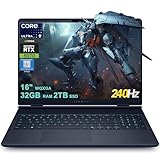
Premium: $2,000 to $2,600 or more. Expect an RTX 5070 or RTX 5080-class GPU, 32GB of RAM, 2TB of storage, a 240Hz panel, and stronger chassis materials or cooling. The MSI Vector 16 HX AI and Alienware 16X Aurora examples sit around $2,399 to $2,408. Those systems make sense for demanding games, streaming, and long-term headroom—not simply because esports requires them.
Warranty and Upgradeability
A one-year limited warranty is common, but read what it covers. Accidental damage, liquid spills, and battery degradation are often excluded. For a laptop costing more than $2,000, an extended plan may be worthwhile if it includes parts, labor, shipping, and a clear repair process.
Check upgrade access before buying. A useful esports laptop should ideally support at least 32GB of RAM, even if it ships with 16GB. Replacing a 512GB SSD with a 1TB or 2TB drive is also relatively straightforward on many models. Some thin laptops solder memory to the motherboard, making the original specification effectively permanent.
Delivery and Setup: Budget Time for Updates
Laptops do not require furniture-style assembly, but setup still takes time. Allow 30 to 60 minutes for Windows updates, graphics drivers, firmware, game launchers, and security software. Confirm that the retailer’s return period begins on delivery and inspect the screen, hinges, ports, keyboard, and charger immediately.
For competitive use, plan a stable desk setup: a hard surface, a cooling stand if the intake is restricted, and a wired Ethernet connection when possible. Wi-Fi 6 or Wi-Fi 7 can be useful, but wireless quality depends on the router, congestion, and distance. A laptop with USB-C, HDMI, and at least two USB-A ports gives you more flexibility for a mouse, headset, external display, and controller.
Spec Checklist
| Spec | Budget | Mid | Premium |
|---|---|---|---|
| Typical price | $900–$1,200 | $1,300–$1,800 | $2,000–$2,600+ |
| Display | 15.6–16 inches, 1920 x 1080 or 1920 x 1200, 144–165Hz | 16–18 inches, 1920 x 1200 or 2560 x 1600, 144–240Hz | 16 inches, 2560 x 1600, 240Hz |
| Graphics | RTX 4050-class | RTX 4060 or RTX 5060-class | RTX 5070 or RTX 5080-class |
| Memory | 16GB DDR5 | 16GB or 32GB DDR5 | 32GB DDR5 |
| Storage | 512GB SSD | 1TB SSD | 2TB SSD or 1TB with a second slot |
| Weight | 4.5–6 pounds | 5–6.5 pounds | 5.5–7 pounds |
Red Flags
- “Gaming” branding without a dedicated GPU: Integrated graphics may be fine for casual titles but are not a strong choice for competitive longevity.
- 8GB of RAM: It can create background-task and multitasking limits. Prefer 16GB, with upgrade access if possible.
- A high refresh rate with no performance match: A 240Hz panel has limited value if the system cannot approach high frame rates in your games.
- Unclear GPU power limits: Two laptops with the same GPU name can perform differently depending on wattage and cooling.
- Small storage: A 256GB drive can become cramped after Windows, updates, and several large games.
- Weak port selection: One USB-A port may be inconvenient when you add a mouse, headset, controller, and external storage.
- Unusually low pricing: Verify the exact processor, GPU, RAM, screen resolution, warranty, and seller before ordering.
FAQ
Is 144Hz enough for esports?
Yes. A 144Hz display is a sensible minimum for competitive play and is a major improvement over 60Hz. Move to 165Hz, 180Hz, or 240Hz if your budget supports it and the laptop can deliver consistently high frame rates.
Do I need an RTX 5080 for competitive gaming?
No. An RTX 4050 or RTX 5060-class laptop can be sufficient for many esports games. Higher-end GPUs are more useful for demanding games, high-resolution displays, ray tracing, streaming, and longer upgrade cycles.
Should I buy a 16-inch or 18-inch gaming laptop?
Choose 16 inches for the best balance of screen area and portability. Choose 18 inches if the laptop will remain on a desk and you value a larger image and potentially stronger cooling over travel convenience.
Is 16GB of RAM enough?
It is enough for most esports games when you are playing without heavy background workloads. Choose 32GB if you stream, edit video, run a browser with many tabs, or want more headroom for future games. Ensure the memory is upgradeable when possible.





