Key takeaways
- 100Hz: A solid budget step up for casual and single-player gaming.
- 144-180Hz: The sweet spot for most gamers wanting smooth, responsive play.
- 240Hz: Best reserved for dedicated competitive esports players.
What's inside
Choosing a gaming monitor can feel overwhelming when every product page throws refresh rates, response times, and panel types at you at once. Yet the display is where all your hardware effort ultimately becomes visible, so getting it right transforms how your games look and feel. In 2026 even affordable monitors offer high refresh rates and adaptive sync, which means the smart move is understanding which specs genuinely affect your experience rather than chasing the biggest numbers.
This guide walks you through the decisions that matter, from resolution and refresh rate to panel technology and sync features, using real examples across popular sizes. Whether you are building a fast esports setup or a balanced all-rounder for immersive single-player games, the sections below will help you match a monitor to your GPU, your desk, and the way you actually play.
As an Amazon Associate we earn from qualifying purchases at no extra cost to you. Product prices and availability are accurate as of the date shown and are subject to change.


⚡ Save on Your Next PC — Amazon Prime
Prime members get fast free shipping on the systems above, plus early access to Prime Day & Black Friday PC deals. New members get a 30-day free trial.
Watch: How To Choose A Gaming Monitor — Video Review
Resolution and Screen Size
Resolution and size go hand in hand. A 24-inch 1080p panel keeps pixels dense and is easy for a modest GPU to drive, making it ideal for competitive play. Step up to 27 inches and QHD 1440p, as seen on the Samsung Odyssey G5 or ASUS TUF VG27AQ3A, and you gain sharper detail that suits immersive games, provided your graphics card can keep the frame rate high at that resolution.
Refresh Rate and Response Time
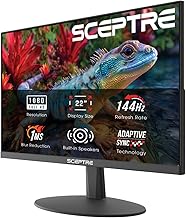
Refresh rate determines how many frames per second the display can show, and it is the spec most tied to smoothness. A 144Hz or 180Hz panel like the Acer Nitro KG241Y or Odyssey G5 feels dramatically fluider than a standard 60Hz screen. Pair that with a 1ms response time to minimize ghosting, and fast-moving action stays crisp and clear during frantic moments.
- 100Hz: A solid budget step up for casual and single-player gaming.
- 144-180Hz: The sweet spot for most gamers wanting smooth, responsive play.
- 240Hz: Best reserved for dedicated competitive esports players.
Panel Type and Color
Panel technology shapes color and viewing angles. Fast IPS panels, such as the one in the ASUS TUF VG27AQ3A with 130% sRGB coverage, deliver vibrant color and wide angles ideal for immersive games and content. VA panels, often found in curved models, offer deeper contrast for darker scenes, while curved screens like Sceptre’s R1500 designs wrap the image slightly to boost immersion at your desk.
Sync Technology and Connectivity
Adaptive sync eliminates screen tearing by matching the monitor’s refresh to your GPU’s output. Look for AMD FreeSync or G-SYNC compatibility, both common even on budget models. Confirm the monitor has the ports you need, typically DisplayPort plus dual HDMI, and check for extras like built-in speakers or a height-adjustable stand that improve day-to-day comfort and cable simplicity.
Frequently Asked Questions
Is 1080p or 1440p better for gaming?
1080p is easier to run at high frame rates and great for esports, while 1440p offers noticeably sharper detail for immersive games. Choose based on your GPU’s power and the resolution it can sustain.
How many Hz do I really need?
144Hz to 180Hz is the ideal range for most gamers, delivering a clearly smoother feel than 60Hz. Only committed competitive players benefit meaningfully from 240Hz and beyond.
Does response time matter?
Yes, a low response time around 1ms reduces motion blur and ghosting in fast scenes. It works alongside refresh rate to keep quick action looking clean and defined.
Should I get a curved monitor?
Curved screens add immersion for single-player and ultrawide setups, especially at larger sizes. For competitive gaming a flat panel is often preferred, so it comes down to personal taste.
Conclusion
The right gaming monitor is the one balanced to your GPU and play style rather than the one with the flashiest spec sheet. Match your resolution to your graphics power, target a 144Hz-plus refresh rate with a low response time, and make sure adaptive sync and the correct ports are present. Get those fundamentals right and any of the panels referenced above will deliver a smooth, sharp experience that makes the rest of your setup shine.