Key takeaways
- Panel type: IPS is the default recommendation at this budget in 2026 — you get noticeably better color accuracy and viewing angles than older TN panels, with response times that are now fast enough for competitive play. Only consider VA if you specifically want deeper blacks and mostly play single-player games.
- Refresh rate vs. your GPU: 144Hz is the practical baseline, but it only helps if your graphics card can feed it. If you’re running an older or entry-level GPU at 1080p, 144Hz is plenty; paying extra for 180Hz or 240Hz is wasted money until you upgrade.
- Adaptive sync support: Look for FreeSync and, ideally, G-Sync Compatible certification. This eliminates screen tearing without the input lag penalty of V-Sync, and it’s the single most impactful feature for making a budget monitor feel smooth.
- Screen size and resolution pairing: At 1080p, 24 inches is the safe choice and 27 inches is the upper limit before pixel density starts to look soft. If you sit close to your desk, a 22–24 inch panel will actually look sharper and be easier to track across in competitive titles.
- Ergonomics and connectivity: Tilt-only stands are common under $300, so check whether height adjustment matters to you or whether you’ll VESA-mount it anyway. Also confirm there’s a DisplayPort input — some budget models push you toward HDMI, which can limit refresh rates on older hardware.
What's inside
Shopping for a gaming monitor under $300 in 2026 sounds easy until you actually start looking. Spec sheets are crowded with overclocked refresh rates, “1ms” response times measured in ways that don’t reflect real gameplay, and HDR badges that mean almost nothing on a budget panel. The result is a market where two monitors with nearly identical listings can feel completely different in a fast-paced shooter.
This guide cuts through that noise. Every monitor below realistically sits within a $300 budget, and most land far beneath it — which matters, because at this price the goal isn’t chasing the biggest number, it’s finding the best balance of panel quality, refresh rate, and build for the money. We’ve focused on 1080p displays between 22 and 27 inches, the sweet spot where budget GPUs can actually push high frame rates, and we’ve flagged where each pick makes sense (and where it doesn’t).
As an Amazon Associate we earn from qualifying purchases at no extra cost to you. Product prices and availability are accurate as of the date shown and are subject to change.




⚡ Save on Your Next PC — Amazon Prime
Prime members get fast free shipping on the systems above, plus early access to Prime Day & Black Friday PC deals. New members get a 30-day free trial.
Watch: Best Gaming Monitor Under $300 — Video Review
How to Choose Gaming Monitor Under $300
- Panel type: IPS is the default recommendation at this budget in 2026 — you get noticeably better color accuracy and viewing angles than older TN panels, with response times that are now fast enough for competitive play. Only consider VA if you specifically want deeper blacks and mostly play single-player games.
- Refresh rate vs. your GPU: 144Hz is the practical baseline, but it only helps if your graphics card can feed it. If you’re running an older or entry-level GPU at 1080p, 144Hz is plenty; paying extra for 180Hz or 240Hz is wasted money until you upgrade.
- Adaptive sync support: Look for FreeSync and, ideally, G-Sync Compatible certification. This eliminates screen tearing without the input lag penalty of V-Sync, and it’s the single most impactful feature for making a budget monitor feel smooth.
- Screen size and resolution pairing: At 1080p, 24 inches is the safe choice and 27 inches is the upper limit before pixel density starts to look soft. If you sit close to your desk, a 22–24 inch panel will actually look sharper and be easier to track across in competitive titles.
- Ergonomics and connectivity: Tilt-only stands are common under $300, so check whether height adjustment matters to you or whether you’ll VESA-mount it anyway. Also confirm there’s a DisplayPort input — some budget models push you toward HDMI, which can limit refresh rates on older hardware.
The Best Picks Reviewed
LG 27G414B-B UltraGear 27-Inch
This is the pick if you want the most screen without leaving the budget category — a 27-inch IPS panel at 144Hz with G-Sync Compatible support, HDR10, and a genuinely useful tilt/height stand that most rivals skip. It’s also one of the few monitors here with built-in speakers and a Switch-friendly input setup, making it a strong all-purpose living-room-or-desk display.
ASUS TUF Gaming VG249QE5A 24-Inch
ASUS’s TUF line has quietly become the safest recommendation in this segment, and the VG249QE5A delivers a fast IPS panel with 144Hz (overclockable to 146Hz), Extreme Low Motion Blur Sync, and variable overdrive that actually reduces ghosting instead of introducing overshoot. The three-year warranty is unusually generous at this price and makes it the low-risk choice for a primary gaming display.
LG 24G411A-B UltraGear 24-Inch
Essentially the compact sibling of the 27-inch model above, this 24-inch IPS panel hits the same 144Hz, 1ms MBR, and G-Sync Compatible checkboxes in a footprint better suited to competitive shooters and smaller desks. The slim stand is tilt-only, so budget for a mount if ergonomics matter — otherwise this is excellent value.
MSI PRO MP243L E14 24-Inch
MSI positions this as an office monitor that games well, and that’s an accurate description: a 144Hz IPS panel with FreeSync, four-side slim bezels, and VESA mounting, plus a VGA port that’s genuinely useful if you’re connecting older hardware. It’s the pick for a dual-purpose work-and-play setup where you want a clean, understated design rather than gamer aesthetics.
Sceptre E225W-FW144 22-Inch
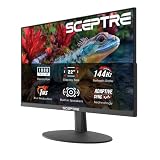
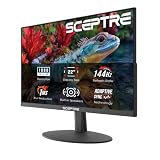
At 22 inches with 144Hz, DisplayPort, and built-in speakers, this Sceptre is aimed squarely at buyers assembling a first gaming setup or a secondary display on a tight budget. Don’t expect IPS-level color or premium build quality, but as a functional high-refresh panel that leaves plenty of budget for the rest of your PC, it does the job.
Frequently Asked Questions
Is 144Hz enough for gaming in 2026?
For the vast majority of players, yes. 144Hz delivers the large, immediately noticeable jump from 60Hz, while the step up to 240Hz produces diminishing returns unless you’re playing competitive shooters at a high level with a GPU capable of sustaining those frame rates.
Should I buy 1080p or save up for 1440p?
Under $300, 1080p is the right call. Budget 1440p monitors typically compromise on panel quality or refresh rate, and 1440p gaming demands significantly more GPU power — money that’s usually better spent on the graphics card itself.
Does “1ms response time” actually mean anything?
Not much on its own, since manufacturers measure it under favorable conditions like MPRT or grey-to-grey transitions. Features like variable overdrive and motion blur reduction, which several picks above include, are better indicators of real-world motion clarity.
Do I need G-Sync Compatible, or is FreeSync fine?
FreeSync works well on AMD cards and, on most modern monitors, on NVIDIA cards too. G-Sync Compatible certification simply means NVIDIA has validated the monitor for flicker-free performance — useful reassurance, but not a dealbreaker if a FreeSync-only model fits your budget better.
Final Thoughts
If you want the strongest overall package under $300, the LG 27G414B-B UltraGear gives you the largest screen with the best stand and the fewest compromises, while the ASUS TUF Gaming VG249QE5A is the more focused competitive choice thanks to its motion clarity features and three-year warranty. Buyers on the tightest budgets should look at the LG 24G411A-B, which delivers most of the UltraGear experience for noticeably less — leaving more room in the build for the GPU that actually drives those frames.