
Key takeaways
- Buying by diagonal size alone: A 32-inch monitor may fit the width of a desk but still be too close for comfortable viewing.
- Ignoring resolution: A 27-inch 1080p display can look less crisp than a 24-inch 1080p display at the same distance. Consider 1440p for most 27-inch gaming monitors.
- Forgetting the stand: The screen may fit, but the base can crowd the keyboard or laptop. Check the full footprint, not only the panel width.
- Assuming refresh rate guarantees performance: A 240Hz monitor does not make a laptop produce 240 frames per second. Match refresh rate to the games and graphics hardware.
- Using a portable monitor as a substitute for a desktop model: Portable screens are excellent for travel and multitasking, but they can have smaller stands, lower brightness, fewer adjustment options, and limited built-in audio.
- Overlooking the power brick: Include the laptop charger, monitor adapter, and cable bend space when measuring the desk.
What's inside
The Short Answer
For most gaming laptops, a 24- to 27-inch external monitor is the best size. Choose a 24-inch model for a compact desk, competitive games, or a viewing distance of about 20 to 28 inches. Choose 27 inches if you want a more immersive image, more room for menus and multitasking, or a viewing distance closer to 28 to 36 inches.
A 15.6-inch portable monitor is useful when you need a second screen that travels with your laptop. It is roughly the same diagonal size as many gaming-laptop displays, with an image area of about 13.6 by 7.7 inches (34.5 by 19.4 cm) in a 16:9 layout. However, a portable monitor is usually a companion screen rather than the best main gaming display.
As an Amazon Associate we earn from qualifying purchases at no extra cost to you. Product prices and availability are accurate as of the date shown and are subject to change.

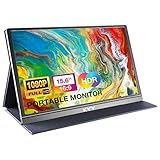


For a primary gaming screen, match size with resolution and desk depth. A 24-inch monitor usually pairs well with 1080p, a 27-inch monitor is most versatile at 1440p, and a 32-inch monitor is best at 1440p or 4K. A large, high-resolution display can look excellent, but your laptop must have enough graphics performance to drive it at the refresh rate you want.
Standard Sizes
The measurements below are approximate screen and monitor-body dimensions for common 16:9 displays. Bezel thickness, stand design, and curved panels can change the final footprint. Screen dimensions refer to the visible display area; body dimensions generally exclude the stand.
| Screen size | Visible image, approximately | Monitor body, approximately | Typical resolution | Best fit |
|---|---|---|---|---|
| 15.6 inches | 13.6 × 7.7 in (34.5 × 19.4 cm) |
14.1 × 8.7 in (35.8 × 22.1 cm) |
1920 × 1080 | Portable second screen, travel |
| 24 inches | 20.9 × 11.8 in (53.1 × 29.9 cm) |
21.7 × 13.0 in (55.1 × 33.0 cm) |
1920 × 1080 | Small desks, esports, everyday gaming |
| 27 inches | 23.5 × 13.2 in (59.7 × 33.6 cm) |
24.3 × 14.5 in (61.7 × 36.8 cm) |
2560 × 1440 | Most gaming desks and mixed use |
| 32 inches | 27.9 × 15.7 in (70.9 × 39.8 cm) |
28.7 × 17.0 in (72.9 × 43.2 cm) |
2560 × 1440 or 3840 × 2160 | Deep desks, immersive single-screen gaming |
| 34 inches ultrawide | 31.3 × 13.1 in (79.5 × 33.3 cm) |
32.0 × 15.0 in (81.3 × 38.1 cm) |
3440 × 1440 | Simulation, racing, productivity |
Remember that monitor sizes are measured diagonally, not horizontally. A 27-inch display is only about 2.6 inches wider than a 24-inch display, but its image area is substantially larger. The stand may add 4 to 8 inches to the monitor’s front-to-back depth, so the listed body dimensions are not a complete desk-space calculation.
How to Measure Your Space
- Measure usable desk width. Measure between speakers, desk edges, shelves, and other equipment. Leave at least 2 inches (5 cm) on each side for ventilation and cable access. A 24-inch monitor generally needs about 22 to 24 inches of clear width, while a 27-inch model needs about 25 to 27 inches.
- Measure desk depth. Measure from the back edge to the front edge, not just the keyboard area. A 24-inch monitor is comfortable on a desk about 20 to 24 inches deep. A 27-inch monitor is easier to position on a desk at least 24 inches deep, and a 32-inch model is more comfortable at 28 to 30 inches or deeper.
- Check viewing distance. Measure from your eyes to the place where the screen will sit. Aim for roughly 20 to 28 inches for a 24-inch screen, 24 to 36 inches for a 27-inch screen, and 30 to 40 inches for a 32-inch display.
- Account for the stand. Look for the manufacturer’s depth measurement with the stand attached. A wide V-shaped base can use more room than a compact rectangular base. A monitor arm can free desk space, but verify that the desk can support its clamp.
- Measure height and eye level. The top edge of the display should be at or slightly below eye level when you sit upright. Include the stand’s height and any laptop riser. A screen that is too tall can force uncomfortable neck movement.
- Plan for the laptop and cables. Add room for the gaming laptop, power brick, mouse, and controller. A high-performance laptop power adapter can be about 6 to 12 inches long and may block nearby outlets or cable ports.
By Room or Use Case
Small bedroom or compact desk
Choose a 24-inch monitor if your desk is less than 48 inches wide or about 24 inches deep. It provides a full-size gaming image without crowding the keyboard and laptop. A 1080p panel keeps graphics demands manageable for many gaming laptops, and a 144Hz to 180Hz refresh rate can be useful for fast games if the laptop supports the required frame rates.
General gaming and schoolwork
A 27-inch monitor is the safest all-purpose choice for most buyers. At 1440p, it offers sharper text and more desktop space than 1080p while remaining large enough for immersive gaming. Allow about 26 inches of width and at least 24 inches of depth, plus additional space if the laptop remains open beside it.
Competitive gaming
For shooters, battle royale games, and esports, a 24-inch 1080p monitor is often easier to scan quickly. Its smaller image can fit naturally within your field of view, and 1080p generally places less load on a laptop GPU than 1440p or 4K. Prioritize refresh rate, response behavior, variable-refresh support, and a comfortable viewing distance over buying the largest screen.
Immersive single-player games
Choose 27 or 32 inches when you want a larger cinematic image. A 32-inch monitor works best on a deep desk, especially if it is curved or paired with speakers. At this size, 1440p is a practical minimum for a sharp image at normal desktop distance, while 4K can provide greater detail if your laptop can maintain playable frame rates.
Travel, dorms, and dual-screen setups
A 15.6-inch portable monitor is the most convenient choice for mobility. The four example models listed for this category range from about $44.99 to $69.99: the MNN model is listed at $49.99, KYY at $69.99, InnoView at $49.99, and ForHelp at $44.99. These screens are close to the size of a laptop display and typically fit in a backpack, but check the folded-case thickness and cable storage before buying.
Portable models may connect through USB-C, HDMI, or both. USB-C is convenient, but confirm that your laptop’s port supports video output; not every USB-C port does. Some portable monitors also need separate power, especially when connected through HDMI. For a permanent desk, a 24- or 27-inch monitor usually offers a larger image, sturdier stand, and easier height adjustment.
Common Sizing Mistakes
- Buying by diagonal size alone: A 32-inch monitor may fit the width of a desk but still be too close for comfortable viewing.
- Ignoring resolution: A 27-inch 1080p display can look less crisp than a 24-inch 1080p display at the same distance. Consider 1440p for most 27-inch gaming monitors.
- Forgetting the stand: The screen may fit, but the base can crowd the keyboard or laptop. Check the full footprint, not only the panel width.
- Assuming refresh rate guarantees performance: A 240Hz monitor does not make a laptop produce 240 frames per second. Match refresh rate to the games and graphics hardware.
- Using a portable monitor as a substitute for a desktop model: Portable screens are excellent for travel and multitasking, but they can have smaller stands, lower brightness, fewer adjustment options, and limited built-in audio.
- Overlooking the power brick: Include the laptop charger, monitor adapter, and cable bend space when measuring the desk.
FAQ
Is a 27-inch monitor too big for a gaming laptop?
No. A 27-inch monitor is a good match when you sit about 24 to 36 inches away and have at least 24 inches of desk depth. Choose 1440p for a sharper image, but check whether your laptop can drive that resolution at the desired refresh rate.
Is a 24-inch or 27-inch monitor better for gaming?
A 24-inch model is better for compact desks and competitive gaming, while a 27-inch model is better for immersive games, productivity, and long-term versatility. If you are undecided and have sufficient space, 27 inches is the more flexible choice.
Can I use a 15.6-inch portable monitor with a gaming laptop?
Yes. It can serve as a second screen for chat, guides, streaming controls, or system monitoring. Confirm the connection type, video-output support, power requirements, and included cables. Its smaller image is convenient to carry but usually less comfortable as a permanent primary display.
What monitor size is best for a 1080p gaming laptop?
Choose 24 inches for the sharpest, simplest pairing with 1080p. A 27-inch 1080p monitor can still work, especially from a greater viewing distance, but pixels are more visible. If you want 27 inches and sit close to the screen, consider a 1440p model instead.





